
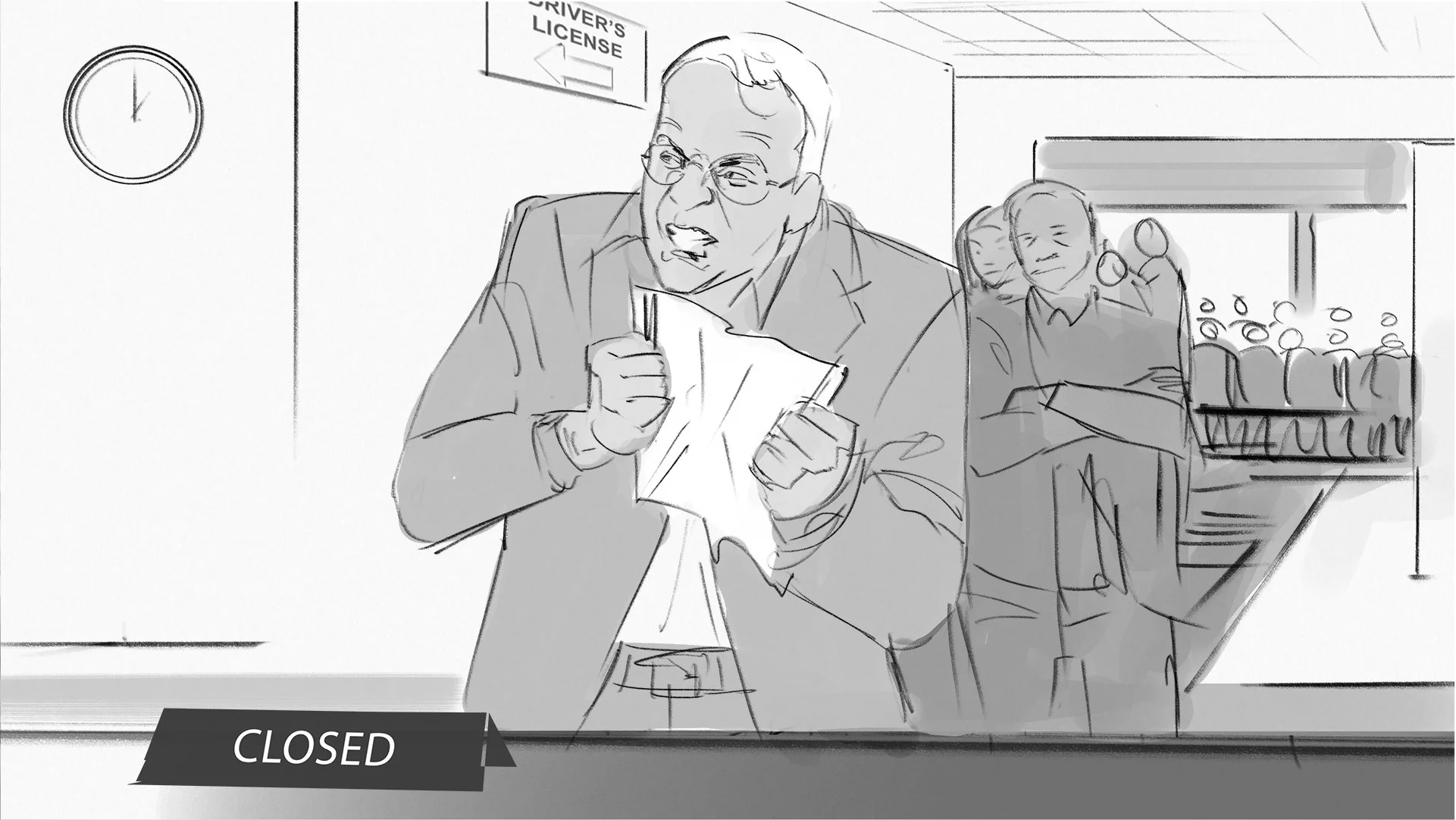
When I first started focusing seriously on gesture drawing, it was because something felt off in my work. The proportions were fine and the anatomy studies were accurate, but the drawings felt posed instead of lived in. That problem shows up quickly in storyboards. You can design a beautiful frame, light it well, and compose it carefully, but if the character’s body does not communicate intention, the scene falls flat. Gesture drawing trains you to see what the body is actually doing, not just what it looks like. At its core, gesture drawing is about capturing the overall action of a pose. Not the muscle groups or costume details or eyelashes, but the action. Every pose has one central movement running through it. A forward drive, a recoil, a twist, a collapse. When you identify that movement first, the drawing holds together. When you ignore it, the figure feels assembled instead of alive. As a professional storyboard artist working in film pre-production, this is something I think about constantly. Before I worry about camera placement or lens choice, I am asking what the character’s body is saying.
The Overall Action Drives the Frame
In figure drawing there is often talk about the line of action. That is not just a technical term. It is the backbone of the pose, a single directional idea that runs through the body and organizes everything else. If a character is grieving, the spine curves forward, the shoulders round, and the head drops as the energy compresses inward. If a character is defiant, the chest opens, the weight settles into the feet, and the head lifts slightly as the energy expands outward. Those physical shifts communicate emotion long before a close-up ever does. When I am boarding a scene for a director, especially in the early stages of visual development, I look for that overall action first. Is the character advancing into the frame or retreating from it? Are they rooted in place or unstable? In cinematic storytelling those decisions shape how an audience feels before dialogue begins. Too often artists approach a pose by outlining parts, building head, torso, arms, and legs like a construction project. Gesture drawing flips that process. You start with movement, then build structure around it. The difference may seem subtle on paper, but on screen it changes everything.
Rhythm, Blocking, and Emotional Weight
Another principle that carries directly from gesture drawing into professional storyboard work is rhythm. If you only trace the outer contour of a body, you might get accuracy, but you lose connection. The human figure is full of opposing curves and counterbalances. One side stretches while the other compresses. The rib cage rotates against the hips. The shoulders tilt in response to weight shifts. When those relationships are understood, the drawing feels cohesive even in a rough state. When they are ignored, the pose feels rigid no matter how polished the rendering is. In storyboard development, especially when collaborating with directors and producers during film pre-production, rhythm keeps frames from feeling static. A well staged scene has visual flow. Characters relate to each other through angle, lean, and direction. If two characters are arguing and both stand upright and squared to camera, the scene reads neutral regardless of what the dialogue says. Shift one character’s weight forward and let the other pull back slightly. Rotate the torso just enough to show tension. Suddenly the emotional dynamic becomes visible. Gesture drawing teaches you to recognize and design those shifts quickly. This is why strong storyboard art does not depend on excessive detail. It depends on confident staging and clear action. Directors looking to hire a storyboard artist are not just looking for someone who can draw. They are looking for someone who understands blocking, performance, and visual storytelling at a structural level.
Emotion is physical before it is verbal. In filmmaking there is often heavy focus on facial performance, subtle eye movement, and micro expressions. Those things matter, but the body usually speaks first. Anxiety raises the shoulders and tightens the neck. Confidence stabilizes the stance and simplifies movement. Grief rounds the back and lowers the head. Even without seeing the face clearly, you can read the emotional truth of a moment if the gesture is honest. This is especially important in wide shots, silhouettes, and action beats where facial nuance disappears. In those situations the storyboard must communicate through posture and weight alone. If the gesture is weak, the emotional beat becomes muddy. If the gesture is committed, the audience understands the moment immediately.
From Gesture Practice to Professional Storyboard Services
Gesture drawing is often practiced in timed sessions, which forces prioritization. You cannot draw everything, so you must decide what matters most. That discipline translates directly into storyboard services during pre-production. Budgets are real and schedules are tight. Endless variation is not helpful. What helps is interpretation and judgment. A professional storyboard artist is not there to generate options without direction, but to interpret the script visually, stage the action, and help the director commit to choices that serve the film. Gesture drawing sharpens that ability because it trains the eye to see the dominant action in a moment and ignore noise. When I am developing storyboards for a feature film, commercial, or pitch, I am constantly reducing complexity to intention. Where is the weight? Who controls the space? Who yields? What is the physical truth of the moment? Those questions matter more than rendering style. Strong gesture leads to strong blocking, and strong blocking supports strong cinematic storytelling.
Blocking is emotional architecture. The physical relationship between characters communicates hierarchy, vulnerability, tension, or intimacy before a single line is delivered. A character who steps confidently into another’s space reads differently than one who hesitates at the edge of the frame. A slight shift in posture can redefine the power dynamic of a scene. In visual development and pre-visualization, these nuances are explored early so that when production begins, the emotional structure is already in place. Gesture drawing strengthens the instinct to see those nuances and to design them intentionally. In an era when images are easy to generate, human judgment still separates frames that feel authentic from those that feel hollow. Software can create polished visuals, but it does not understand weight, hesitation, or resolve in the human body. Gesture drawing builds that understanding over time and keeps the focus where it belongs, on action and meaning rather than surface detail.
If you are directing a project and want to strengthen the physical storytelling in your film, that work starts in development. It starts before cameras roll. It starts with clear, intentional staging built on real human movement. Strong gesture leads to strong boards, and strong boards support stronger films. If you are looking to hire a storyboard artist who approaches visual storytelling through movement, rhythm, and human behavior, I would be glad to talk through your project.
📩 Reach out: paul@paultemplestudios.com
🎨 Explore more: www.paultemplestudios.com
Want more blog posts on this topic?
1. Setting the Emotional Tempo: How Storyboards Shape the Audience’s Experience
2. Shooting Boards for Action Scenes: Why Every Great Action Scene Starts on Paper
3. See It Before You Shoot It: The Power of Shooting Boards