• Home
  • Film
  • Advertising
  • Super Bowl LVII
  • Clients
  • Blog
  • Contact
Menu

Paul Temple Studios

  • Home
  • Film
  • Advertising
  • Super Bowl LVII
  • Clients
  • Blog
  • Contact
×

Behind the Boards: A Blog by Artist, Paul Temple

Welcome to the blog! Here you'll find insights into the art of storyboarding, concept development, shooting boards, and visual storytelling for film, television, and advertising. From camera planning techniques to the emotional impact of character design, this is where I’ll share my expertise honed over a decade of working with directors and top brands. Whether you're a creative director, filmmaker, or agency looking to elevate your pitch, this blog reveals how powerful visuals drive unforgettable stories.

Questions? Email me at paul@paultemplestudios.com

Concept art from Firelight Creative’s “Eden’s Twilight” film pitch. Art by Paul Temple.

Concept art from Firelight Creative’s “Eden’s Twilight” film pitch. Art by Paul Temple.

Drawing Faith to the Screen: Storyboards and Concept Art for Christian Filmmaking

Paul Temple September 15, 2025

Christian filmmaking has grown into one of the most influential movements in modern media. Studios like AFFIRM Films, Angel Studios, and Kingdom Story Company are not only creating box office hits, they are proving that faith-based stories resonate with global audiences. The rise of films like I Can Only Imagine, War Room, and series like The Chosen has shown that stories rooted in scripture and faith are not just niche. They are powerful, relevant, and commercially successful.

What ties all these productions together is the same thing that ties together every great film: clarity of vision. And that is where storyboards and concept art come in.

As a storyboard artist and illustrator, I work with directors and producers to translate words on the page into images that can guide everything from fundraising to final production. In Christian filmmaking, where the stories are sacred and the budgets are often tighter, the need for precise, faith-driven visual storytelling is even greater.

Why Christian Films Need Storyboards and Concept Art

In secular filmmaking, producers often have the luxury of assuming their audience will engage because of spectacle, celebrity, or genre appeal. Faith-based films are different. They must connect emotionally and spiritually while staying true to scripture and accessible to broad audiences.

Storyboards and concept art help bridge that gap. For fundraising, they show potential investors exactly what a scene will look like on screen. A passage from Genesis about Noah building the ark becomes more than words. With concept art, it becomes a fully realized image of wood, rainclouds, and laboring hands, ready to stir belief and financial backing.

During production, boards guide directors and cinematographers through the complex language of film. Whether it is a resurrection scene requiring reverence and restraint, or a comedic beat in a modern Christian family film, the timing, framing, and pacing can all be solved before the camera ever rolls.

Fundraising with Faith

Angel Studios has perfected the fan-funded model, proving that Christian audiences are willing to invest in content they believe in. But convincing backers is not just about passion, it is about presentation.

When a script is accompanied by concept art and storyboards, the pitch stops being abstract. It becomes tangible. Investors and supporters can see the Red Sea parting, or Christ calming the storm, before a single dollar is pledged. That vision builds trust. It reassures backers that the production team has both artistic clarity and technical competence to carry a project through.

I have worked on pitches where the boards themselves were enough to unlock funding. In one case, a series of frames depicting a biblical battle gave producers the confidence to approach distributors. The story was no longer confined to words. It was a moving, visual journey waiting to be filmed.

Keeping True to the Source

One of the greatest responsibilities of Christian filmmaking is handling scripture with accuracy and care. Studios like Pinnacle Peak Pictures and Provident Films understand this well, as do directors like the Erwin Brothers and Kendrick Brothers. When portraying biblical events, there is no room for careless staging.

Storyboards act as a safeguard. They force us to consider how each verse translates visually. Should the camera linger on the prodigal son’s embrace with his father, or on the crowd of onlookers? How do we present Christ’s miracles in a way that emphasizes faith rather than spectacle?

These decisions must be made with both artistry and reverence. Working through them in storyboards prevents costly mistakes later, ensuring that when the audience sees the film, they are moved spiritually as well as cinematically.

Modern Christian Stories on Screen

Not all Christian films are set in biblical times. Many, like I Can Only Imagine or Fireproof, deal with modern characters wrestling with faith in contemporary settings. Storyboards are just as crucial here.

Take a scene set in a church basement, where a family confronts their struggles. The performance may carry the emotion, but the boards dictate how the camera frames that intimacy. Does it hold wide to show isolation, or move in close to emphasize reconciliation? The visual language matters.

Faith-based producers like Kingdom Story Company and JCFilms Studios recognize that today’s audiences are visually literate. They expect the same level of sophistication in Christian films as they do in mainstream Hollywood. Storyboards help deliver that standard without compromising the message.

Learning from the Pioneers

Christian filmmakers stand on the shoulders of giants. Billy Graham understood the power of film decades ago, using media to spread the gospel worldwide. Dave Christiano built a foundation for faith-based storytelling with films like The Daylight Zone. Today, Dallas Jenkins has elevated the field with The Chosen, combining cinematic ambition with community-driven support.

What unites them is not just faith, but clarity of communication. Every great Christian film starts with someone who can take a story from scripture or personal testimony and make it cinematic. That is the exact purpose of storyboards and concept art.

Working with Directors and Writers

One of my favorite aspects of storyboard work is collaborating with directors and writers. In Christian filmmaking, this collaboration carries added weight. Writers want to honor the biblical text. Directors want to craft engaging cinema. Producers want to ensure the message reaches audiences.

My role is to align those goals visually. A script might say, “Jesus teaches the crowd,” but how large is the crowd? Where does the camera sit? Do we see the sea behind him, or do we focus on the expressions of the listeners?

These are not small details. They are choices that affect tone, meaning, and audience connection. By working through them in storyboard form, we give the entire team a visual grammar to speak from.

Faith on a Global Stage

Studios like AFFIRM Films and Angel Studios have already shown that Christian stories can compete with the biggest blockbusters. With platforms like streaming and international distribution, faith-based films are no longer confined to Sunday-school circles. They are shaping mainstream culture.

As Christian filmmaking continues to grow, the demand for professional pre-visualization will only increase. Funders, distributors, and audiences want to know that these stories are not only faithful, but also cinematic. Storyboards and concept art provide that proof.

Why the Human Touch Matters

Some people ask why a studio should invest in a human storyboard artist when software can generate images instantly. The answer lies in intention. A machine can produce an image, but it cannot wrestle with scripture. It cannot weigh the theological implications of how Christ is depicted on screen. It cannot collaborate with a director who is worried about whether the miracle looks reverent or theatrical.

The Lord uses real people to fulfill His will — real people who are filled with the Holy Spirit. Those people are guided in their decisions, and equipped with discernment to make choices that honor God’s story. Human illustrators bring that same discernment to Christian filmmaking. They do not just draw what looks good; they consider the narrative, the audience, and the leadings of the Holy Spirit. In faith-based projects, that discernment is everything.

Closing Thoughts

Christian filmmaking is not a passing trend. It is a movement that has proven its staying power, with studios like AFFIRM, Pinnacle Peak, and Angel Studios leading the charge, and producers like the Erwin Brothers and Kendrick Brothers creating films that resonate with millions.

As a storyboard artist, my goal is to help that movement continue by giving filmmakers the tools they need to tell stories with clarity and conviction. Whether it is raising funds with compelling concept art or guiding a director with shooting boards, the work is always about serving the story, the audience, and ultimately, the Lord.

Faith on screen deserves no less.

📩paul@paultemplestudios.com
🎨paultemplestudios.com

Want more blog posts on this topic?
1. Concept Art and Storyboards for Indie Film Crowdfunding
2.
Composition and Control: The Cinematic Science Behind a Great Frame
3.
Setting the Emotional Tempo: How Storyboards Shape the Audience’s Experience

In Film, Christian Tags Concept art, Storyboards, Shooting boards, Directors, Producers, faith-based, christian, biblical, bible, Angel Studios, Kendrick Brothers, AFFIRM, Pinnacle Peak
Comment
Storyboard frame for an Audible by Amazon ad pitch. Art by Paul Temple.

Storyboard frame for an Audible by Amazon ad pitch. Art by Paul Temple.

Storyboard Revisions: Knowing When to Refine and When to Simplify

Paul Temple September 11, 2025

Revisions are inevitable. If you work in advertising or film, you already know this. A storyboard rarely sails through untouched, and honestly, that is part of the job. Clients, directors, and creative teams have ideas to test, details to tweak, and sometimes whole scenes to rethink. The real skill is not just in drawing the first draft but in knowing how to handle revisions. Do you push harder and add more detail, or do you strip back and keep it simple? That choice can make or break the usefulness of your boards.

I have spent years working with agencies, production houses, and directors who all bring different styles of feedback. Some want to see every frame polished like a finished illustration. Others want quick adjustments to staging or timing so they can test ideas without getting stuck in the weeds. Over time, I have learned that revisions are not just corrections. They are opportunities to decide how much the storyboard should carry and how much should be left open for the director and crew to interpret.

Why Revisions Happen

Before talking about how to handle them, it helps to acknowledge why revisions exist in the first place. Advertising campaigns change because clients are weighing brand identity, legal clearances, and sometimes personal taste. Film boards change because story beats shift, a line of dialogue gets cut, or the budget forces a different approach. None of this is unusual.

A storyboard is a conversation. It is a tool for testing how ideas will look and feel before money is spent on production. Revisions are a sign that people are engaging with your work. The challenge is figuring out how far to take each round of changes.

Knowing When to Push

Pushing a storyboard means leaning in with more detail, more nuance, and more cinematic intention. These are the moments when you add shading, refine expressions, lock down camera angles, and clarify staging so no one misreads the plan.

I push harder when:

  • The timing is critical. Comedy spots, action beats, or visual reveals often need exact framing. If a gag depends on a half-second pause or a glance timed just right, the boards must show it clearly.

  • Talent is involved. When the client is paying for a big-name actor, the boards need to capture likeness and gesture. The team wants to imagine how the star will look in the scene. Vague sketches will not cut it.

  • The production scale is large. If there are stunts, special effects, or expensive set pieces, clarity is everything. You cannot leave the director or cinematographer guessing. Pushing detail here prevents expensive mistakes later.

  • The director asks for it. Some directors are highly visual. They want boards that feel almost like a graphic novel so they can pitch confidently to the client or communicate with the crew.

When I push, I think of the board as a tool that has to do heavy lifting. It is not just about selling the idea but ensuring that timing, scale, and intent are crystal clear.

Knowing When to Simplify

On the other hand, sometimes the smartest move is to strip things back. A storyboard does not always need to be a finished illustration. In fact, too much detail can distract from the conversation. When the boards look too polished, clients might argue over the color of a jacket instead of the flow of the story.

I simplify when:

  • The concept is still evolving. If the creative team is still exploring big-picture ideas, fast sketches are better. They show intent without locking the director into specifics that may change tomorrow.

  • Speed is more important than polish. In pitches or early client meetings, the priority is getting ideas in front of people quickly. Spending hours rendering shadows and textures is wasted time if the whole idea is about to shift.

  • The revision is minor. If the only note is to change the angle of a hand or swap the background setting, there is no reason to redraw the entire frame with full detail. A simple fix communicates just as well.

  • The director prefers flexibility. Some directors like to keep things open so they can explore on set. For them, storyboards are guidelines, not mandates. Simpler boards encourage creativity rather than boxing them in.

Simplifying is not about doing less work. It is about respecting the process. Sometimes the most efficient path forward is a clean, readable sketch that gives space for ideas to keep breathing.

Reading the Room

The trickiest part of revisions is reading the room. Not every client wants the same level of detail, and not every director communicates in the same way. Some teams need every beat spelled out, while others just want reassurance that the story holds together.

Part of my job is figuring out who needs what. If I am working with a comedy director, I know timing is going to be everything, so I lean into precision. If I am working with an agency team still shaping their pitch, I focus on speed and clarity rather than polish. If the creative director wants boards that feel like finished artwork to impress a client, I adjust for that too.

Good storyboard work is not just about drawing. It is about listening and adapting. Revisions are signals, and if you read them well, you can figure out how far to push or how much to simplify.

The Danger of Overworking

One mistake I see often is overworking boards. It is tempting to polish every frame until it looks portfolio-ready, but that can be a trap. The more detail you pour into the drawings, the easier it becomes for clients to nitpick things that do not actually matter at that stage. Suddenly the conversation shifts from storytelling and shot flow to “why does the actor’s jacket look that color” or “can the background be more detailed.” Those are production questions, not storyboard questions.

I learned this the hard way. On one project, the boards were so polished they looked like finished illustrations. The client fell in love with them as if they were the final look of the film. Once production began, the reality of the budget, the lighting, and the set design could not possibly match the illustrated perfection. Instead of being excited by the shoot, the client felt let down because they had already “seen” a version of the film that was too ideal. The boards had set the wrong expectation.

That experience taught me something important: storyboards are not supposed to be the final product. Their job is to map the rhythm of the story, the flow of shots, the timing of the beats, and the placement of the camera. When boards get too detailed, they distract from that role. Clean, readable drawings are often more effective because they focus everyone’s attention on the sequence, not on the surface polish.

The truth is, a board only needs enough detail to communicate the action, mood, and framing. Anything more risks pulling energy away from what matters most.

The Value of Efficiency

Every revision is a negotiation between clarity and speed. The goal is not to make the prettiest drawing but to make the clearest communication tool. That means balancing effort with impact. If a change will make the story flow better, it is worth pushing. If a change is cosmetic, simplify.

Efficiency also builds trust. Directors and producers do not want to feel like revisions are going to slow down the process. If you can show that you can pivot quickly, keeping the boards useful without burning through time, you become an asset to the team.

Collaboration Through Revisions

The best revisions are not battles. They are collaborations. A director who sees you adjusting boards to support their vision will trust you more. An agency that knows you can deliver changes overnight will keep calling you back.

Revisions give you a chance to show that you are more than just an illustrator. You are part of the storytelling team. Sometimes that means pushing detail to help everyone see the scene more vividly. Other times it means simplifying so the idea stays flexible. Knowing the difference is what separates a technician from a collaborator.

Final Thoughts

Revisions are not the enemy. They are part of the process, and how you handle them can make a huge difference in how useful your boards are. The art is in knowing when to push and when to simplify. Push when the timing, talent, or scale demands it. Simplify when the idea is still forming or when polish will only slow things down.

After more than a decade of drawing for agencies, directors, and studios, I have learned that revisions are where the real value of a storyboard artist shows. Anyone can draw a first pass. It takes experience to know how to adjust, how to listen, and how to keep the boards serving the story.

At the end of the day, the measure of a storyboard is not how pretty it looks on a wall. It is how well it communicates the vision and keeps the production moving forward. That is why revisions matter. They are not setbacks. They are the fine-tuning that makes sure the train runs on time.

📩 Reach out: paul@paultemplestudios.com
🎨 Explore more: www.paultemplestudios.com

Want more blog posts on this topic?
1. From Pitch to Production: Winning Clients with Storyboards
2.
Commercials Are Short Films: Why Storyboards Matter Even More in 30 Seconds
3.
Storyboards and Cinematography: Speaking the Same Language

In Storyboards, Advertising, Film
Comment
Black and white storyboard frame of Ben Stiller in Pepsi Zero Sugar’s Super Bowl ad. Art by Paul Temple.

Black and white storyboard frame of Ben Stiller in Pepsi Zero Sugar’s Super Bowl ad. Art by Paul Temple.

Landing the Laugh: Storyboarding Pepsi Zero Sugar’s Super Bowl Spots

Paul Temple September 8, 2025

Super Bowl commercials come with massive pressure. Millions of viewers, huge budgets, and A-list talent all waiting for the perfect joke to land. For the 2023 Pepsi Zero Sugar campaign, “Great Acting or Great Taste,” my job as the storyboard artist was to make sure every punchline, every comedic beat, and every subtle visual gag translated perfectly before cameras rolled.

The concept was simple in words but tricky in execution: challenge viewers to question whether they were enjoying the soda because it tasted great or because the actors were selling it so convincingly. The ads featured Ben Stiller and Steve Martin, two legends of comedy, and the campaign leaned into absurd humor that required precise timing and carefully planned visuals.

Working on this project, I was especially excited about the inclusion of Zoolander references. Anyone who knows me knows that movie is a personal favorite. Stiller’s over-the-top facial expressions and gestures, along with the nods to the fashion world, gave me plenty of material to craft storyboards that were both clear and playful.

Translating Humor to the Page

Comedy on-screen isn’t just about dialogue. It’s timing, body language, reaction shots, and subtle gestures. As a storyboard artist, my challenge is to take the written script and make sure the humor reads visually before the first take.

For example, in one spot, Ben Stiller’s hesitation before delivering a line needed to look awkward but intentional. The pause had to feel natural, yet exaggeration would make the gag hit harder. My storyboards broke down each frame, showing exact gestures, facial reactions, and camera framing.

Steve Martin’s comedic timing is famously understated, which presents a different kind of challenge. His reactions often carry the punchline. By mapping his expressions and movements in advance, the boards ensured nothing was lost in translation. This is especially important in Super Bowl spots where every second counts and audiences expect precision.

The Zoolander nods added another layer. One sequence had Stiller glancing at a model on set, mimicking his Zoolander signature moves. Planning these moments visually allowed the director to see the gag unfold frame by frame, making sure the joke wasn’t too subtle for the Super Bowl audience but still clever enough for fans of the movie.

Collaboration with Directors and Talent

One of the coolest parts of this project was seeing how storyboards became a communication tool with the talent. Ben Stiller personally reviewed the boards and provided notes on how he wanted certain gestures, pauses, or expressions adjusted. Getting that level of input directly from an actor of his caliber was amazing and gave me a chance to refine the visuals before production.

Steve Martin’s team also relied heavily on the boards. They helped confirm camera placements, timing of reactions, and how physical comedy would translate to the final cut. The boards weren’t just a blueprint; they were a conversation tool between director, actors, and crew. They allowed everyone to get on the same page before the first camera rolled.

By visualizing these comedic beats in advance, we could experiment with framing and staging options that would have been impossible to tweak on set without adding cost and time. The boards also helped directors see exactly where the humor would land, and where it needed to be exaggerated or toned down.

Scene-by-Scene Humor Breakdown

The first spot with Steve Martin set up the premise: are you enjoying Pepsi Zero Sugar because it tastes good, or because the acting is just that convincing? My storyboards captured Steve in each scenario: the DMV meltdown, disappointment over a tiny plate at a restaurant, his calm precision as a surgeon, and gloating over a board game victory against a child. Every gesture, glance, and expression was mapped so the audience could instantly read his acting while questioning if he was genuinely enjoying the soda. Comedic timing had to be perfect. By planning each frame, the director could focus on performance rather than figuring out the visual setup.

Ben Stiller’s spot featured battling a sci-fi creature, proposing in a restaurant, falling for a robot, and finally reprising his Zoolander character drinking Pepsi Zero Sugar. Each pose, expression, and micro-reaction was storyboarded to balance humor with narrative clarity. Stiller even gave personal notes on the boards, adjusting moments to hit just the right punch, making collaboration a highlight of the project.

Timing was critical in both spots. A millisecond off could ruin a joke, so each frame was plotted to ensure the punchlines landed exactly as intended. Storyboards gave the directors confidence, letting them focus on performance while I handled the precise visual storytelling.

Production Efficiency Without Losing Comedy

Super Bowl productions are high-pressure environments. Budgets are tight, and every second on set counts. By providing detailed storyboards, we reduced the need for reshoots and minimized downtime. The boards clearly communicated camera angles, actor movements, and comedic timing, which meant the crew could anticipate setups and lighting changes in advance.

For a campaign like this, efficiency doesn’t just save money. It preserves the humor. When actors know exactly how a scene will play visually, they can focus on performance rather than improvising or guessing what the director wants. The boards act as a guide for the entire team, keeping everyone aligned without slowing down the energy on set.

Storyboards also prevent miscommunication. A single gesture, glance, or expression can make or break a joke. By illustrating it in advance, we make sure that every visual element contributes to the humor without ambiguity. The director can see the gag, approve it, and move forward with confidence.

Why Hand-Drawn Storyboards Matter

While previsualization software and digital tools are popular, hand-drawn boards bring a level of nuance and clarity that is hard to replicate. A sketch can emphasize exaggeration or subtlety, show exact timing, and convey the intent behind a gesture or expression.

In this campaign, subtle nuances made a huge difference. Stiller’s smirk, a slight tilt of the head, or Martin’s understated reaction all had to be visible to the audience within a second or two. Hand-drawn boards allowed me to control every detail of how the joke would be seen.

Moreover, hand-drawn storyboards are inherently adaptable. As Ben Stiller suggested tweaks, I could adjust the illustrations on the spot, showing new ideas immediately. The human touch allowed us to iterate rapidly without losing the original comedic intention.

Extending the Campaign

After the initial spots aired during the Super Bowl, the campaign extended to include additional ads and tie-ins. Storyboards helped maintain consistency. They ensured that new sequences kept the same comedic timing, character gestures, and tone.

For example, a follow-up spot included more Zoolander references. Having detailed boards from the initial campaign meant we could plan new gags that fit seamlessly, preserving the humor while introducing fresh material. Directors and actors could quickly understand the intended joke without needing lengthy explanations.

Storyboards also assisted with editing. When multiple takes were available, editors could use the boards to choose the version that matched the visual intention. Every decision, from pacing to gesture emphasis, was guided by the storyboard.

Conclusion

The Pepsi Zero Sugar “Great Acting or Great Taste” campaign is a perfect example of how storyboards are essential for landing humor on screen. From Ben Stiller’s hilarious Zoolander nods to Steve Martin’s thoughtful gestures, every comedic moment was carefully mapped, planned, and refined before cameras rolled.

Working directly with the talent, especially getting notes from Stiller himself, was an unforgettable part of the process. It reinforced how storyboards are not just technical tools; they are a medium for collaboration, communication, and perfecting the performance before production begins.

For creative directors and filmmakers, this campaign demonstrates the value of detailed storyboards. They save time, prevent headaches, and most importantly, ensure the jokes land. When humor is the heart of your story, nothing should be left to chance, and that’s exactly where storyboards come in.

Whether you’re planning a Super Bowl spot or a smaller branded content piece, investing in high-quality storyboards gives you a blueprint for timing, gestures, and expressions that keeps your audience laughing and engaged.

📩 Reach out: paul@paultemplestudios.com
🎨 Explore more: www.paultemplestudios.com

Want more blog posts on this topic?
1. Continuity in Streaming: How Storyboards Guide Episodic Shows
2.
Building the Perfect Reveal in Storyboards
3.
Understanding Context and Subtext: Why Choosing the Right Storyboard Artist Matters

In Advertising, Film, Storyboards
Comment
Storyboard for “Black Demon” film. Art by Paul Temple.

Storyboard for “Black Demon” film. Art by Paul Temple.

Building the Perfect Reveal in Storyboards

Paul Temple September 4, 2025

There are few things more satisfying in film or advertising than a reveal that lands. The doors swing open, the product comes into view, or the hero steps out of the shadows. When done right, it feels effortless. When done wrong, you can almost hear the audience shrug.

As a storyboard artist, I spend a lot of my time building those moments. The “big reveal” might look like one perfect frame in the finished film, but it usually takes a lot of drawings, bad ideas, and timing tweaks to get there. Think of it as visual carpentry: the camera is your hammer, the pacing is your nails, and if you cut the wood just a hair too short, the whole thing wobbles.

Let’s dig into how I approach reveals in storyboards, why it takes more than software to pull one off, and how the human touch makes all the difference.

What Counts as a “Reveal”?

A reveal can be as simple as pulling the lid off a new burger in a commercial, or as complex as Luke discovering the truth about Darth Vader. In both cases, the audience is leaning in, waiting for that payoff.

Reveals usually fall into three categories:

  1. Object reveals – the shiny car, the bottle of perfume, the new phone.

  2. Character reveals – a villain stepping into frame, a romantic lead making eye contact for the first time.

  3. Information reveals – the twist, the hidden note, the “oh no, the call is coming from inside the house” moment.

As a storyboard artist, my job is to figure out how to set those moments up visually so the director, cinematographer, and editor all have a roadmap for how it will play out.

Building Anticipation Before the Payoff

A reveal without anticipation is just a cut.

If I draw a storyboard that shows the product sitting on a table from the very first frame, we’ve lost the suspense. But if I draw hands unwrapping a box, a close-up of paper tearing, maybe a shadow creeping across the table, suddenly the audience is leaning forward.

It’s the difference between:

  • Frame 1: Here’s the car.

  • Frame 2: Still the car.

  • Frame 3: More car.

…versus…

  • Frame 1: A close-up of headlights flicking on in the dark.

  • Frame 2: A slow push as we see chrome details in shadow.

  • Frame 3: The car emerges under a spotlight, polished and powerful.

Same product. Very different impact.

Timing: The Invisible Ingredient

Timing is where the human touch matters most.

A reveal drawn too quickly doesn’t feel dramatic. Drag it out too long and people get restless. You need that Goldilocks middle zone where the moment stretches just enough, then snaps into payoff.

Here’s where I act as a story consultant. I’m not just drawing pretty frames. I’m helping a director communicate the grammar of the scene: how long to hold a beat, when to cut, where to place the camera so the surprise feels natural and earned.

Software can spit out renders or fill in gaps, but it can’t feel the rhythm of an audience’s heartbeat. Humans do.

Composition and the Art of Withholding

A big part of storyboarding a reveal is deciding what not to show.

I’ll often sketch frames where the subject is half-hidden, behind a door, cropped by the edge of the panel, obscured in shadow. This creates curiosity. The audience starts asking, “What am I not seeing?” And curiosity is the fuel of every good reveal.

Sometimes it’s as simple as drawing a close-up of a character’s reaction before showing what they’re reacting to. Other times it’s hiding a product in plain sight but only spotlighting it when the moment is right.

The principle is the same: restraint makes payoff possible.

Why Human Instinct Matters

You could ask, “Why can’t this just be automated?” After all, there are algorithms that know where to place a camera, how to light a scene, even how to generate a dozen variations of a shot in seconds.

But a reveal is more than geometry and rendering. It’s about human psychology.

  • I know when a shot feels too obvious.

  • I know when the setup isn’t paying off emotionally.

  • I know when the audience is smarter than the trick we’re trying to pull.

These are judgment calls, not math problems. They come from experience, taste, and yes, gut instinct. A storyboard artist is a filter, making sure the reveal doesn’t just happen, but actually works.

Case Study: The Product Drop

Let’s say I’m storyboarding a spot for a new pair of running shoes. The brief says: “Make them look fast, desirable, and different.”

If I draw the shoes sitting on a pedestal under bright lights, sure, they look nice. But if I storyboard:

  • Frame 1: A runner lacing up in shadow.

  • Frame 2: A shot of feet pounding the pavement in blur.

  • Frame 3: A freeze as dust clears, revealing the new shoes in full clarity.

Now we’ve built a reveal. The product isn’t just shown. It’s earned.

The Role of Sound in Visual Planning

Even though I don’t draw sound, I think about it constantly.

Is there a music swell before the reveal? A pause of silence right before the object drops into frame? Sound is invisible in a storyboard, but the rhythm of the panels has to leave room for it.

That’s another reason the human hand matters. I’m thinking in terms of beats, not just images. A good reveal storyboard is practically a metronome for the director and editor.

Collaboration: The Reveal as Team Sport

The truth is, I’m not the only one responsible for a great reveal. Storyboarding is just one piece of the process.

The director has to trust the vision, the DP has to light it, the editor has to pace it, and the actors (or product handlers) have to deliver.

My job is to give everyone a shared map. When I draw a reveal well, I’m not just solving problems for myself, I’m making the entire team’s job easier.

Why I Love Reveals

I’ll be honest: reveals are some of my favorite things to storyboard.

They’re puzzles. They’re challenges. They force me to think like an audience member and a filmmaker at the same time. And when I get it right, there’s a rush in knowing that somewhere down the line, a room full of people will gasp, laugh, or sit forward in their seats because of a sequence I sketched out with a pencil.

That’s why the human touch matters. A reveal isn’t just a technical beat. It’s an emotional one. And emotions don’t come from algorithms. They come from people telling stories to other people.

Final Frame

So, the next time you watch a movie and a villain steps out of the dark, or you see a commercial where a product appears at just the right moment, remember: that didn’t happen by accident. Someone drew it first. Someone thought about the timing, the composition, the psychology, and the anticipation.

And if that someone did their job right, you didn’t just see the reveal…you felt it.

That’s the difference a storyboard artist brings to the table. That’s the difference the human touch makes.

📩 Reach out: paul@paultemplestudios.com
🎨 Explore more: www.paultemplestudios.com

Want more blog posts on this topic?
1. Landing the Laugh: Storyboarding Pepsi Zero Sugar’s Super Bowl Spots
2.
Understanding Context and Subtext: Why Choosing the Right Storyboard Artist Matters
3.
The Human Element: Why Observation Still Beats AI in Visual Development

In Storyboards, Film, Shooting Boards
Comment
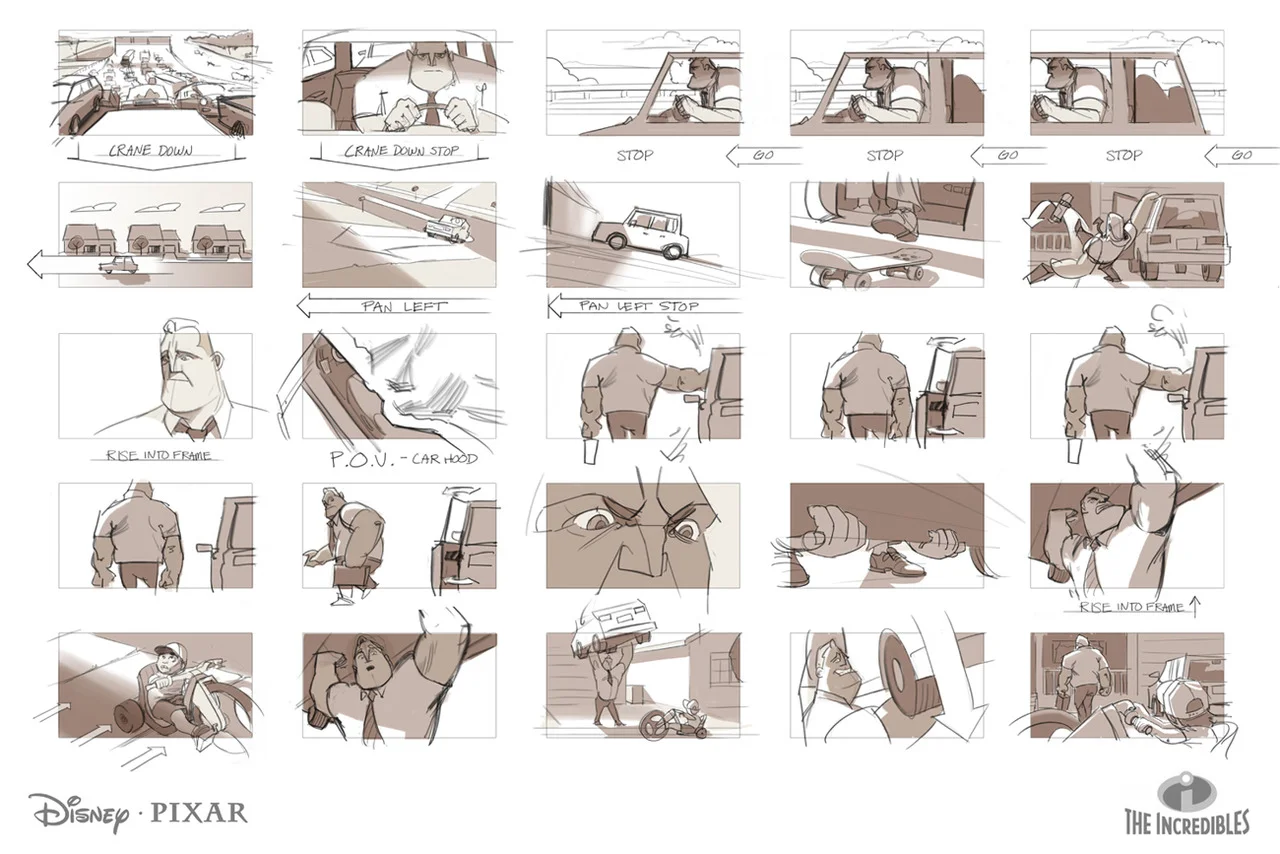
Shooting boards exercise featuring scenes from Disney/Pixar’s The Incredibles. Art by Paul Temple.

Shooting boards exercise featuring scenes from Disney/Pixar’s The Incredibles. Art by Paul Temple.

What Filmmakers Want from Shooting Boards: Save Time, Money and Communicate Clearly

Paul Temple September 2, 2025

In filmmaking, the words “time is money” are not just a cliché. They are the foundation of how projects are planned, budgeted, and executed. Shooting boards and storyboards have become one of the most trusted tools for filmmakers because they offer something rare in the creative process: clarity. But when a director or producer hires a storyboard artist, what are they really asking for? It is not just drawings. It is confidence. It is alignment. It is the ability to see the film before the cameras ever roll. In this post, I want to walk through what filmmakers actually want from shooting boards, why they matter in every stage of production, and how a professional storyboard artist brings value beyond sketches.

The Real Need Behind Shooting Boards

Every filmmaker, no matter their style, has one thing in common: they want their vision executed on screen as closely as possible to what they imagine. Shooting boards are a way of translating those ideas into a language that the entire crew can understand. They strip away confusion and provide a visual blueprint. When a filmmaker sits down with a storyboard artist, what they want most is not art for art’s sake, but a tool that communicates ideas so clearly that misinterpretation is almost impossible.

In essence, shooting boards are pre-visualizations. They are the bridge between the creative chaos of brainstorming and the logistical reality of production. They help directors ask the right questions early. Do we really need a crane shot? Can this dialogue scene be covered in three setups instead of five? Should the camera move or should the actors move? By committing these questions to paper, filmmakers reduce uncertainty and avoid costly mistakes.

Clarity in Communication

One of the biggest challenges on any set is communication. Directors know what they want in their heads, but explaining that vision to a director of photography, production designer, stunt coordinator, or VFX supervisor can feel like a game of telephone. Shooting boards cut through that problem by showing rather than telling.

Imagine trying to describe a complicated tracking shot verbally. You can talk about camera movement, subject framing, and timing, but without visuals there is room for misunderstanding. A shooting board can present that same idea in a single frame or sequence of frames. Every department can look at it and instantly understand how their work supports the shot.

This clarity saves time during production, when every minute matters. Crews no longer have to guess. They do not have to stop and ask for clarification. They already know what is expected because the visual plan has been laid out ahead of time.

Efficiency That Saves Money and Headaches

Filmmaking is expensive. Sets are built, gear is rented, and crews are paid by the day. Every unnecessary delay or mistake has a price tag attached. Shooting boards are a form of insurance against waste.

By planning shots in advance, filmmakers can identify unnecessary setups or overly complex sequences that will eat up valuable time on set. A single drawing might reveal that a complicated crane move could be replaced with a simpler handheld shot without losing impact. That realization saves hours of setup and thousands of dollars in equipment and labor.

Shooting boards also streamline the workflow for the entire crew. The assistant director can build a schedule around them. The cinematographer can plan lenses and lighting. The art department knows exactly what needs to be built or dressed in the background. When everyone works from the same visual guide, production runs smoother, faster, and with fewer surprises.

Creative Confidence

Filmmakers are often working under pressure, balancing creative ambition with practical limitations. Shooting boards provide a form of rehearsal on paper. They allow directors and cinematographers to test ideas visually before committing time and money to them.

This rehearsal creates creative confidence. A director might be unsure if a scene plays better with static shots or moving cameras. By sketching both options, the filmmaker can compare pacing and emotional tone before stepping on set. The board becomes a safe space to experiment without risk.

That confidence matters not only to the director but also to the team. When a crew sees detailed shooting boards, they gain trust in the project. They know the director has a plan. They know what they are working toward. That shared confidence raises morale and helps everyone perform at their best.

Preventing Production Risks

Miscommunication on set can derail even the most carefully planned shoot. Missing shots, continuity errors, or unclear blocking can force costly reshoots or leave a story broken in the editing room. Shooting boards reduce these risks by making potential problems visible before cameras roll.

For example, a board might reveal that two planned shots will not cut together smoothly, or that an actor’s eyeline does not match. Spotting those issues early allows the team to adjust before wasting time and money on set. Shooting boards are not just about inspiration. They are about risk management.

The Storyboard Artist as a Creative Partner

This is where the role of a professional storyboard artist becomes crucial. A filmmaker can sketch rough ideas themselves, but an experienced artist does more than draw. They act as a story consultant. They know how to translate abstract concepts into cinematic language. They understand pacing, framing, camera movement, and how images flow together.

When I work with filmmakers, my role is to listen carefully to their ideas and then transform them into visuals that serve both the creative vision and the practical needs of production. I think about how the boards will be used on set. I design them to be clear, direct, and readable in the fast-paced environment of filmmaking. My job is to bring clarity, not confusion.

In this sense, the storyboard artist is a collaborator. We help directors and producers sharpen their ideas, avoid pitfalls, and communicate more effectively with their teams. The value is not only in the drawings but in the problem solving that comes with them.

Real-World Reflections

Spend a few minutes on any filmmaker discussion forum and you will see the same theme repeated: storyboards and shooting boards are not outdated. They remain vital tools because they make collaboration possible. Directors on Reddit often emphasize that boards keep the crew aligned and eliminate misunderstandings. Others point out how they save time during both shooting and editing by clarifying the intended rhythm of a scene.

This sentiment comes up again and again. In a world where filmmaking technology evolves constantly, from digital cameras to virtual production, the need for clear visual planning has not gone away. If anything, it has grown stronger. The more complex productions become, the more valuable shooting boards are in keeping everyone aligned.

The Takeaway for Filmmakers

At the end of the day, what filmmakers want from shooting boards is not simply a set of pictures. They want peace of mind. They want to know that their vision is clear, their team is aligned, and their production is protected from unnecessary risks.

Hiring a storyboard artist is one of the smartest investments a filmmaker can make. The boards will save time, reduce costs, and boost creative confidence. They will help turn imagination into reality with fewer headaches along the way.

Filmmaking is always a balance of art and logistics. Shooting boards sit at the intersection of both. They allow directors to dream boldly while still giving producers the reassurance that the dream can be executed. That is why they remain one of the most important tools in the filmmaker’s toolkit, and why working with an experienced storyboard artist can make the difference between a production that struggles and one that succeeds.

📩 Reach out: paul@paultemplestudios.com
🎨 Explore more: www.paultemplestudios.com

Want more blog posts on this topic?
1. How Shooting Boards Help Indie Filmmakers Compete with Studio Productions
2.
Common Mistakes Directors Avoid with Shooting Boards
3.
Shooting Boards for Action Scenes: Why Every Great Action Scene Starts on Paper

In Shooting Boards, Film Tags shooting boards, Preproduction, film, directors
Comment
← NewerOlder →

Search Posts


Featured Blog Posts

Featured
Composition and Control: The Cinematic Science Behind a Great Frame
Nov 3, 2025
Composition and Control: The Cinematic Science Behind a Great Frame
Nov 3, 2025
Nov 3, 2025
Storyboards and Cinematography: Speaking the Same Language
Sep 25, 2025
Storyboards and Cinematography: Speaking the Same Language
Sep 25, 2025
Sep 25, 2025
Concept Art and Storyboards for Indie Film Crowdfunding
Sep 18, 2025
Concept Art and Storyboards for Indie Film Crowdfunding
Sep 18, 2025
Sep 18, 2025
Breathing Life Into Your Characters: The Importance of Good Character Design
Aug 21, 2025
Breathing Life Into Your Characters: The Importance of Good Character Design
Aug 21, 2025
Aug 21, 2025
 

Latest Blog Posts

Featured
The Silhouette Test: Why Character Design Starts with Simple Shapes
Dec 8, 2025
The Silhouette Test: Why Character Design Starts with Simple Shapes
Dec 8, 2025
Dec 8, 2025
The Fake Perfect Trap and Why Lived In Art Wins Every Time
Dec 4, 2025
The Fake Perfect Trap and Why Lived In Art Wins Every Time
Dec 4, 2025
Dec 4, 2025
How Shooting Boards Help Indie Filmmakers Compete with Studio Productions
Dec 2, 2025
How Shooting Boards Help Indie Filmmakers Compete with Studio Productions
Dec 2, 2025
Dec 2, 2025
The Human Element: Why Observation Still Beats AI in Visual Development
Nov 10, 2025
The Human Element: Why Observation Still Beats AI in Visual Development
Nov 10, 2025
Nov 10, 2025
Nov 6, 2025
Studying Light: Lessons from the Masters of Painting
Nov 6, 2025
Nov 6, 2025
Composition and Control: The Cinematic Science Behind a Great Frame
Nov 3, 2025
Composition and Control: The Cinematic Science Behind a Great Frame
Nov 3, 2025
Nov 3, 2025
Shooting Boards for Action Scenes: Why Every Great Action Scene Starts on Paper
Oct 30, 2025
Shooting Boards for Action Scenes: Why Every Great Action Scene Starts on Paper
Oct 30, 2025
Oct 30, 2025
World-Building: The Art of Making Environments Feel Alive
Oct 27, 2025
World-Building: The Art of Making Environments Feel Alive
Oct 27, 2025
Oct 27, 2025
How Classical Painting Shaped Modern Filmmaking
Oct 22, 2025
How Classical Painting Shaped Modern Filmmaking
Oct 22, 2025
Oct 22, 2025
Common Mistakes Directors Avoid with Shooting Boards
Oct 8, 2025
Common Mistakes Directors Avoid with Shooting Boards
Oct 8, 2025
Oct 8, 2025

© Paul Temple Studios 2012-2025 All Rights Reserved. Unauthorized use of content from this website is prohibited.