
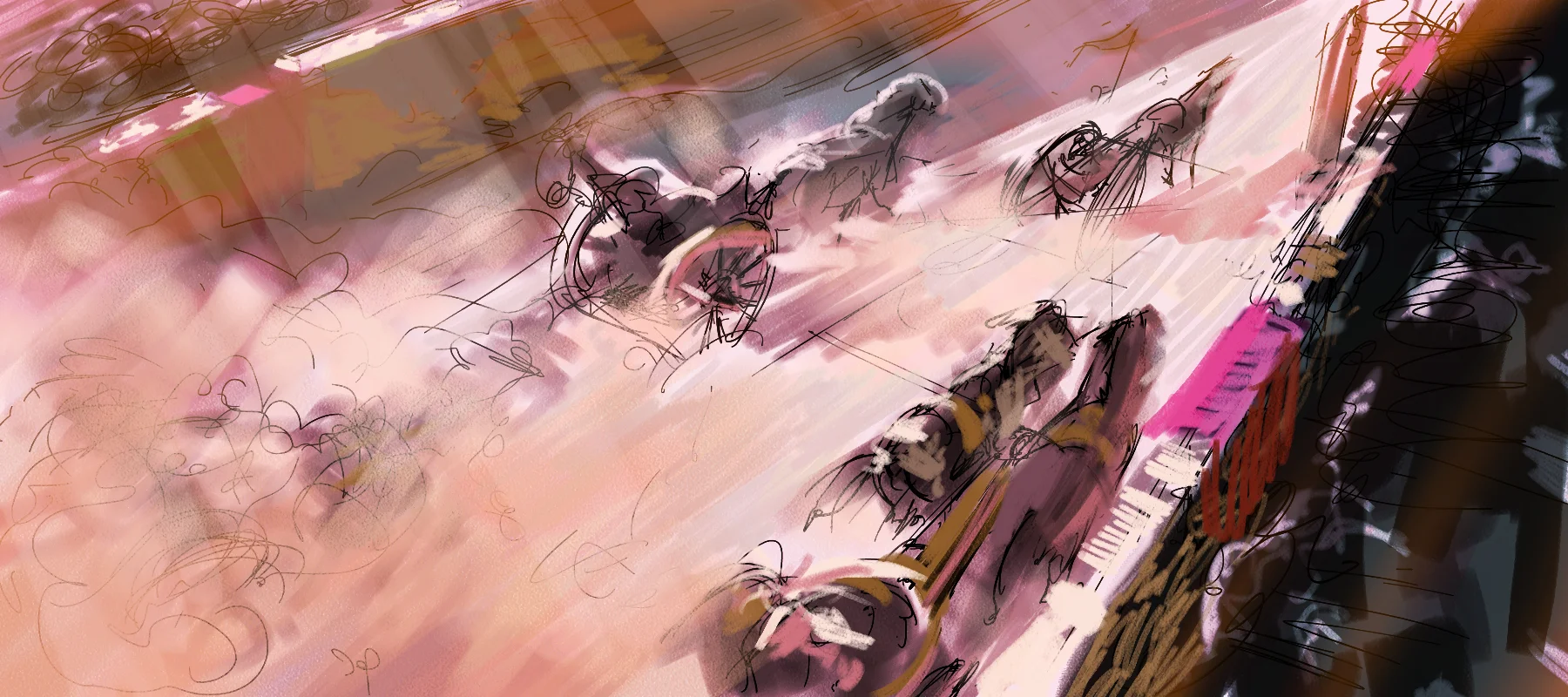
I just wrapped up boarding action scenes for a feature, and the work has brought up something I find amazing about storyboarding. Some of the best visual ideas don't come from sitting down and trying to invent something clever. They show up while you're drawing.
You can read a script several times, break down the action, map out the geography, and make a plan for the camera coverage. All of that is important, but the drawings introduce another way of thinking about the story. Once the panels start taking shape, you can compare compositions, camera angles, and movement across different parts of the film. Sometimes a shot from an early scene starts to feel connected to something much later in the story. A camera move that worked for one moment might have an entirely different meaning when it returns near the end.
Those connections can be easy to miss when you're only looking at the script. They become much more apparent when you can see the images together.
What You Discover Once You Start Drawing
Script analysis gives you the structure, the action, and the emotional beats you're trying to communicate. Drawing forces you to make specific decisions about how those things will appear on screen. Where is the camera? What is the character doing? How does the audience understand the geography? What does the composition emphasize? As you work through those questions, you're making visual choices that can be compared with the rest of the film.
I've noticed this happening on the current feature. While boarding a later action sequence, I started seeing a connection to a camera angle and tracking move from an earlier confrontation. The two scenes weren't necessarily asking for the same treatment, but there was something about the movement and composition that felt related. After exploring a few versions, it became clear that bringing back that visual idea could give the later scene a stronger connection to the earlier one.
The interesting part was how the idea developed. It wasn't something I had identified during the initial script breakdown. It became apparent through the drawings. By adjusting the framing and changing the energy of the camera move, the later sequence could echo the earlier moment while giving it a different purpose. That kind of visual repetition can help a film feel connected without having to explain the connection through dialogue.
Finding Visual Rhymes Across a Film
A visual rhyme is a repeated composition, camera movement, or visual arrangement that takes on a different meaning when it appears again. Filmmakers use these connections in all kinds of ways. A character might be framed in a similar way at the beginning and end of a film, but the change in their circumstances makes the repeated composition feel different. A camera move might introduce a location early in the story and return to that same space during the climax. The setting hasn't changed, but what happens there has.
Character entrances are another great example, particularly when introducing a villain. Imagine the first time we meet an antagonist. Perhaps they enter from the same side of the frame each time, emerging slowly from the background or appearing behind another character. The camera might hold a wide composition and allow them to move into the space, rather than cutting directly to a close-up. That entrance establishes a visual pattern. Later, when the audience sees that same movement or framing, they recognize it. Even before the character does anything, the image creates a sense of anticipation.
You can take that idea further by changing the context while keeping the visual language consistent. A villain might initially enter a room from a dark doorway, framed at a distance. Later, they might enter a much larger space using the same composition, making them feel even more imposing. Or perhaps an early entrance places them behind the hero, almost unnoticed, while a later scene gives them the entire frame. The repeated visual idea connects the moments, but the change in scale and staging tells the audience that the stakes have grown.
These choices influence how an audience feels about a character. A recurring entrance can create dread, signal danger, or establish a character's control over a scene. The audience may not consciously identify the repeated camera language, but they recognize the pattern and respond to it. That's the value of visual storytelling. The composition is helping tell the story before the dialogue gets involved.
The challenge is knowing when a repeated visual idea actually helps. Repetition for its own sake can feel obvious or unnecessary. The connection needs to contribute something to the story, whether that's a sense of payoff, a shift in perspective, or a reminder of something the audience has seen before.
Why Action Scenes Are Particularly Useful
Action sequences create some interesting opportunities for this kind of discovery because they require very specific visual decisions. The audience needs to understand where the characters are, how they're moving, and how each action relates to the next. The camera has to give us the right information without making the sequence feel like a diagram.
That means you're constantly solving problems involving perspective, staging, screen direction, movement, and composition. A shot might need to establish the geography of a space, while the next needs to bring us close enough to understand a character's reaction. A camera move might follow the action, reveal something important, or change our understanding of the environment.
Once those decisions are drawn, they become part of the film's visual vocabulary. You can look back at earlier scenes and see whether a particular angle, movement, or composition could be used again. The demands of an action sequence often lead to strong, simple visual solutions, and those solutions can have value beyond the scene you originally created them for.
For a storyboard artist, this means paying attention to more than the immediate action. I'm looking at how the sequence works, but I'm also keeping an eye on the visual language established elsewhere in the film. A little comparison can sometimes reveal a much stronger approach.
The Value of Seeing the Film as a Whole
For directors, this kind of exploration can be especially useful during film pre-production. Storyboards give you a way to look at individual scenes while keeping the larger structure of the film in view. You can evaluate whether a camera move introduced early in the story has an opportunity to return, whether a composition could reinforce a character's development, or whether two sequences would benefit from a stronger visual relationship.
It also gives the cinematographer and other department heads something concrete to discuss. A repeated camera move might influence how a scene is staged or photographed. A visual motif might affect lighting, production design, or the way a location is introduced. The editor may eventually find that the connection between two moments gives a cut more weight.
None of that needs to be complicated. Sometimes it's simply a matter of recognizing that two scenes have something in common and finding a visual way to make the audience feel it.
For productions with limited time or resources, working through these possibilities in storyboards can be particularly helpful. It gives the director an opportunity to test the idea and consider its practical demands while there is still room to make changes. It is much easier to adjust a composition on a page than to discover during production that a planned shot doesn't quite work.
Leaving Room for Discovery
I usually approach the first pass of an action sequence by concentrating on clarity. The geography needs to make sense, the movement needs to read, and the camera choices need to support the action. Once those fundamentals are in place, I can start looking at the sequence more closely and considering how it relates to the rest of the film.
That second look is often where some of the more interesting ideas appear. I might recognize a composition from an earlier scene, see an opportunity to repeat a camera move, or find a way to connect two moments visually. Sometimes the idea works immediately. Other times it takes a few rounds of drawing to find the right balance.
I think that's one of the more interesting parts of working as a storyboard artist. You're solving the immediate visual problems, but you're also helping shape how the audience will experience the film as a whole. The drawings give you a chance to examine those relationships and see what might be possible.
On the current feature, working through the action has reminded me how much can be discovered this way. Some of the strongest connections between scenes weren't obvious when I first read the script. They emerged as the panels developed and I could compare the visual decisions across the story. That's one of the reasons I enjoy the process. You start with a sequence that needs to be figured out, and somewhere along the way, the drawings can reveal an idea that makes the larger film work a little better.
If you're developing a feature and need storyboards or shooting boards, I can help work through the action, camera choices, and visual structure of your sequences. It's worth having someone involved who is thinking about how each scene works on its own and how it fits into the film around it.
📩Reach out: paul@paultemplestudios.com
🎨Explore more: paultemplestudios.com
Want more blog posts on this topic?
1. The Value of a Story Partner in Visual Storytelling
2. Storyboards and Cinematography: Speaking the Same Language
3. Hiring a Storyboard and VisDev Artist: A Step by Step Guide for Filmmakers and Directors