

J.C. Leyendecker’s work still stops me when I flip through old magazines or illustration collections. The figures feel larger than life, the compositions are clean, and every stroke looks deliberate. He worked at the highest level of commercial art while keeping a standard of craft that most fine artists would envy. That combination is rare, and it is something I think about often when I sit down to board a scene or develop visuals for a film.
Leyendecker was born in Germany in 1874 and came to America as a boy. He trained in Chicago and later studied in Paris at the Académie Julian. By the early 1900s he was already one of the most sought-after illustrators in the country. He painted 322 covers for The Saturday Evening Post, more than Norman Rockwell, who considered him both a friend and a mentor. He created the New Year’s Baby that still appears on cards and covers every January. And he invented the Arrow Collar Man, an idealized image of American manhood that sold shirts by the millions and became a cultural icon of its own.
He did personal work. He also did some of the most successful advertising of his era. That balance is part of what draws me to him. He understood that commercial work did not have to mean compromised work.
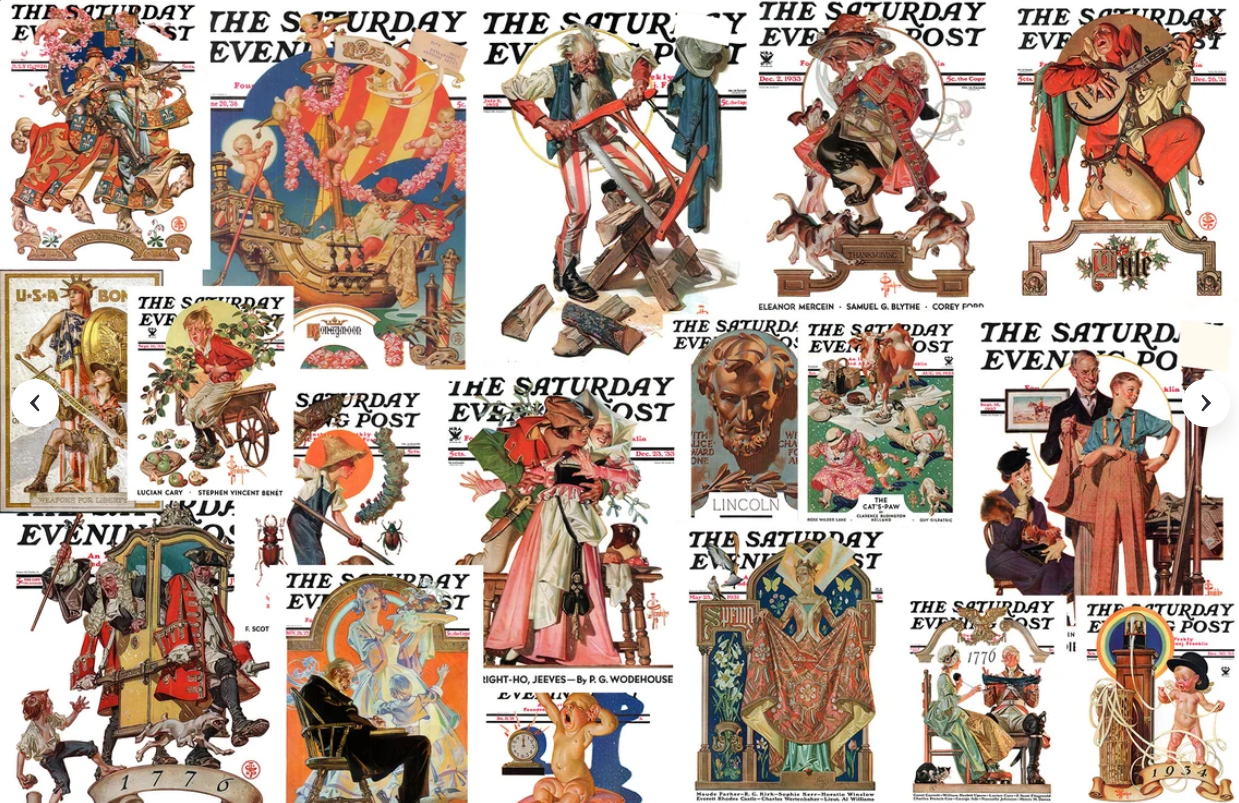
Collection of Saturday Evening Post magazine covers by J.C. Leyendecker.
Technique and Particular Talents
Leyendecker had a superb grasp of anatomy. His figures were stylized, often with slightly larger hands and smaller heads that gave them a heroic presence, yet the underlying structure was always solid. You can feel the bones and muscles working under the clothing. His compositions were simple but beautifully balanced in form and light. He rarely cluttered a picture. Every element had a job to do.
His process was thorough. He began with small thumbnail sketches to explore the idea. Once he had the design locked, he expanded it to full size using a squared-up grid, a classical method that kept the proportions true. He made careful studies of every part of the picture before committing to the final painting. Contemporary accounts note that his finals often looked loose and lively, but that freedom came from intense preparation. He had already solved the problems in smaller versions.
His brushwork is distinctive. He used hard-edged parallel strokes, often in a hatching pattern, to model form and blend color. Highlights and shadows are crisp and intentional. He played with color in skin tones in ways that still look surprising today, slipping in unexpected hues that give the figures a kind of quiet energy. He also kept a library of small sketches of poses, hands, drapery, and details that he could pull from when needed, the way many of us now keep photo references.
He guarded a particular oil medium that he used for his final paintings. The exact formula is lost, but the results are still visible: a surface that holds both precision and a certain soft luminosity.
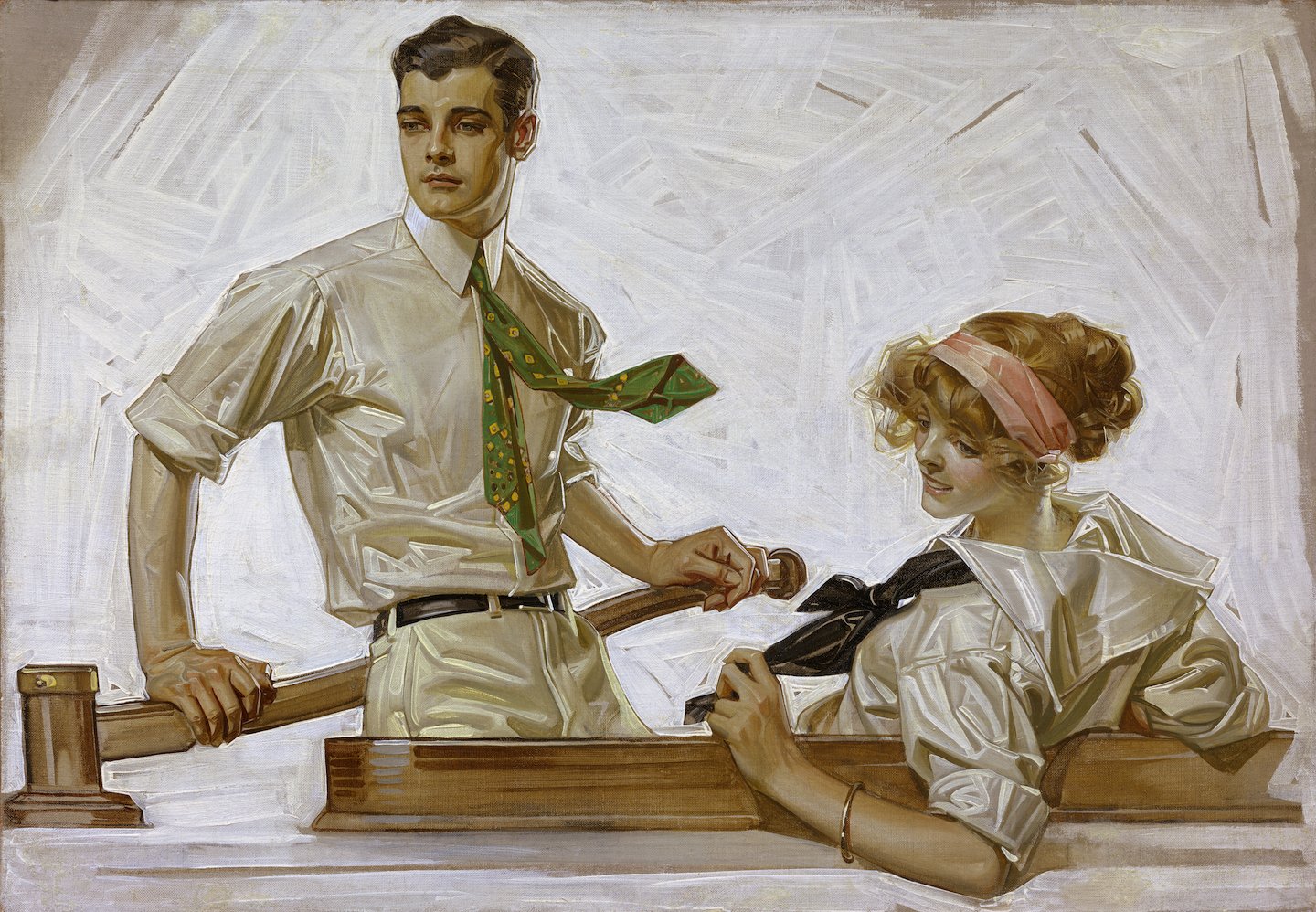
Illustration by J.C. Leyendecker.
Personal Inspiration
What stays with me most is that Leyendecker treated commercial illustration with the same seriousness that many artists reserve only for personal work. He lived a disciplined studio life while enjoying the rewards of success. He was devoted to his younger brother Frank, also an illustrator, and later to Charles Beach, who became his primary model for the Arrow Collar Man, his household manager, and his lifelong companion.
I respect artists who can move between personal exploration and client work without losing their standards. In my own practice I still make time for plein air watercolor, film photography, and personal drawing. Those activities keep my eye sharp and give me material that later shows up in storyboards and visual development. Leyendecker’s example reminds me that the commercial side of the job does not have to feel secondary. A clear, well-designed image that sells a product or tells a story can still be honest work.
Why This Matters for Directors and Art Directors
When I board a sequence or develop the look of a film, I am solving many of the same problems Leyendecker faced. How do I make the figure read clearly at a glance? How do I balance the composition so the eye moves where it should? How do I use light and value to create mood without overcomplicating the frame? How do I keep the anatomy solid so the performance feels real even in a rough sketch?
A real artist brings years of looking, drawing, and living to those decisions. You can generate images quickly now, but speed alone does not replace the ability to choose the right pose, the right framing, or the right emotional emphasis. Leyendecker’s work shows what happens when an artist takes the time to prepare thoroughly and then executes with confidence. The results feel inevitable rather than accidental.
Directors and art directors benefit from that kind of thinking in pre-production. Strong boards and clear visual development help the entire team understand the intention behind a scene. They reduce expensive surprises later. They give the cinematographer, the production designer, and the actors a shared visual language to work from.
Wrapping It Up
J.C. Leyendecker remains one of the clearest examples of an artist who combined commercial success with lasting craft. His anatomy, his compositions, his disciplined preparation, and his ability to create iconic images still reward close study. He proved that advertising and illustration could carry real artistic weight when the person behind the work cared about the fundamentals.
If you are directing a film or leading a creative project and want storyboards and visual development grounded in strong draftsmanship, clear design, and real experience, I would be glad to talk through your work. We can build visuals that serve the story with the same care and clarity that masters like Leyendecker brought to their own assignments.
📩 Reach out: paul@paultemplestudios.com
🎨 Explore more: www.paultemplestudios.com
Want more blog posts on this topic?
1. Carrying the Legacy of Film Illustrators Forward
2. Edgar Payne on Composition: Lessons for Film Work
3. George Bridgman: The Anatomy Teacher Behind Generations of Artists