• Home
  • Film
  • Advertising
  • Super Bowl LVII
  • Clients
  • Blog
  • Contact
Menu

Paul Temple Studios

  • Home
  • Film
  • Advertising
  • Super Bowl LVII
  • Clients
  • Blog
  • Contact
×

Behind the Boards: A Blog by Artist, Paul Temple

Welcome to the blog! Here you'll find insights into the art of storyboarding, concept development, shooting boards, and visual storytelling for film, television, and advertising. From camera planning techniques to the emotional impact of character design, this is where I’ll share my expertise honed over a decade of working with directors and top brands. Whether you're a creative director, filmmaker, or agency looking to elevate your pitch, this blog reveals how powerful visuals drive unforgettable stories.

Questions? Email me at paul@paultemplestudios.com

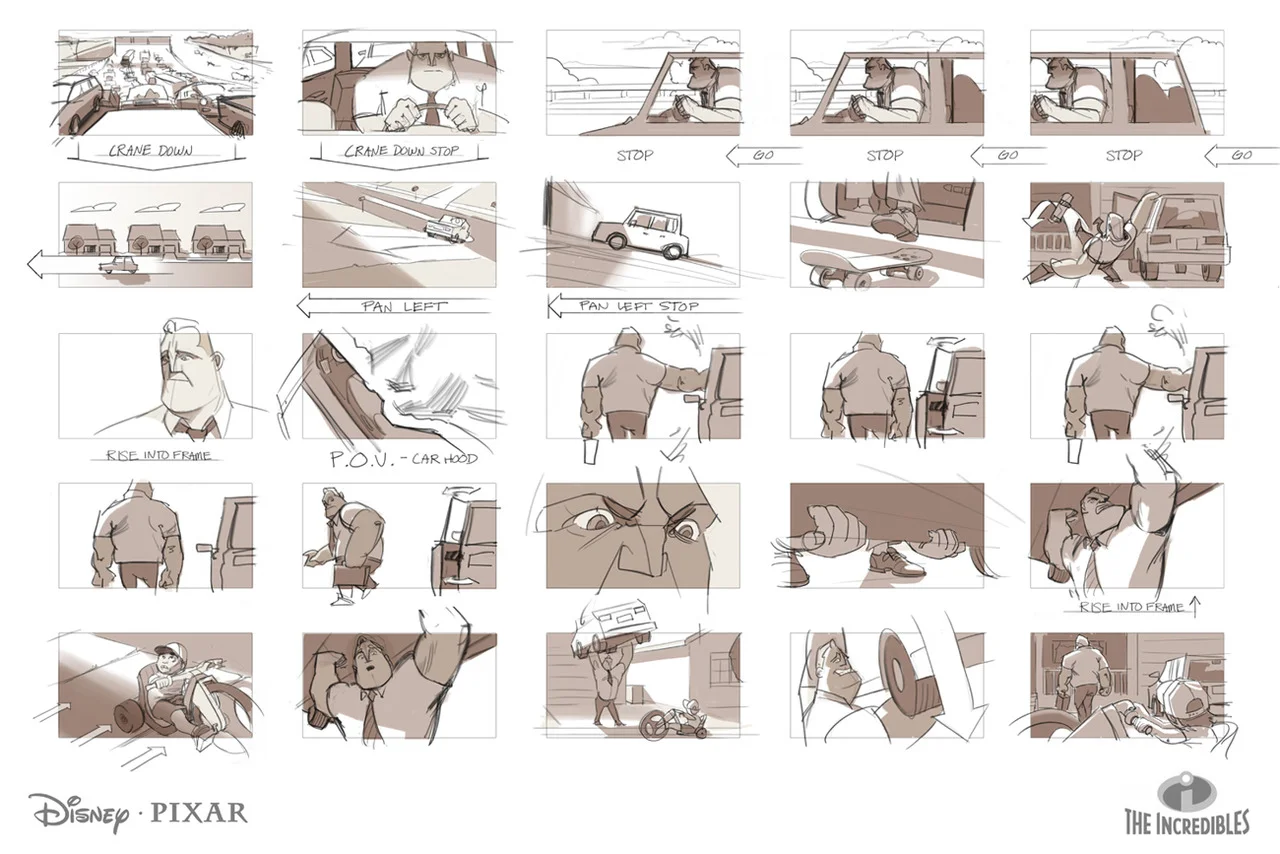
Shooting boards exercise featuring scenes from Disney/Pixar’s The Incredibles. Art by Paul Temple.

Shooting boards exercise featuring scenes from Disney/Pixar’s The Incredibles. Art by Paul Temple.

What Filmmakers Want from Shooting Boards: Save Time, Money and Communicate Clearly

Paul Temple September 2, 2025

In filmmaking, the words “time is money” are not just a cliché. They are the foundation of how projects are planned, budgeted, and executed. Shooting boards and storyboards have become one of the most trusted tools for filmmakers because they offer something rare in the creative process: clarity. But when a director or producer hires a storyboard artist, what are they really asking for? It is not just drawings. It is confidence. It is alignment. It is the ability to see the film before the cameras ever roll. In this post, I want to walk through what filmmakers actually want from shooting boards, why they matter in every stage of production, and how a professional storyboard artist brings value beyond sketches.

The Real Need Behind Shooting Boards

Every filmmaker, no matter their style, has one thing in common: they want their vision executed on screen as closely as possible to what they imagine. Shooting boards are a way of translating those ideas into a language that the entire crew can understand. They strip away confusion and provide a visual blueprint. When a filmmaker sits down with a storyboard artist, what they want most is not art for art’s sake, but a tool that communicates ideas so clearly that misinterpretation is almost impossible.

In essence, shooting boards are pre-visualizations. They are the bridge between the creative chaos of brainstorming and the logistical reality of production. They help directors ask the right questions early. Do we really need a crane shot? Can this dialogue scene be covered in three setups instead of five? Should the camera move or should the actors move? By committing these questions to paper, filmmakers reduce uncertainty and avoid costly mistakes.

Clarity in Communication

One of the biggest challenges on any set is communication. Directors know what they want in their heads, but explaining that vision to a director of photography, production designer, stunt coordinator, or VFX supervisor can feel like a game of telephone. Shooting boards cut through that problem by showing rather than telling.

Imagine trying to describe a complicated tracking shot verbally. You can talk about camera movement, subject framing, and timing, but without visuals there is room for misunderstanding. A shooting board can present that same idea in a single frame or sequence of frames. Every department can look at it and instantly understand how their work supports the shot.

This clarity saves time during production, when every minute matters. Crews no longer have to guess. They do not have to stop and ask for clarification. They already know what is expected because the visual plan has been laid out ahead of time.

Efficiency That Saves Money and Headaches

Filmmaking is expensive. Sets are built, gear is rented, and crews are paid by the day. Every unnecessary delay or mistake has a price tag attached. Shooting boards are a form of insurance against waste.

By planning shots in advance, filmmakers can identify unnecessary setups or overly complex sequences that will eat up valuable time on set. A single drawing might reveal that a complicated crane move could be replaced with a simpler handheld shot without losing impact. That realization saves hours of setup and thousands of dollars in equipment and labor.

Shooting boards also streamline the workflow for the entire crew. The assistant director can build a schedule around them. The cinematographer can plan lenses and lighting. The art department knows exactly what needs to be built or dressed in the background. When everyone works from the same visual guide, production runs smoother, faster, and with fewer surprises.

Creative Confidence

Filmmakers are often working under pressure, balancing creative ambition with practical limitations. Shooting boards provide a form of rehearsal on paper. They allow directors and cinematographers to test ideas visually before committing time and money to them.

This rehearsal creates creative confidence. A director might be unsure if a scene plays better with static shots or moving cameras. By sketching both options, the filmmaker can compare pacing and emotional tone before stepping on set. The board becomes a safe space to experiment without risk.

That confidence matters not only to the director but also to the team. When a crew sees detailed shooting boards, they gain trust in the project. They know the director has a plan. They know what they are working toward. That shared confidence raises morale and helps everyone perform at their best.

Preventing Production Risks

Miscommunication on set can derail even the most carefully planned shoot. Missing shots, continuity errors, or unclear blocking can force costly reshoots or leave a story broken in the editing room. Shooting boards reduce these risks by making potential problems visible before cameras roll.

For example, a board might reveal that two planned shots will not cut together smoothly, or that an actor’s eyeline does not match. Spotting those issues early allows the team to adjust before wasting time and money on set. Shooting boards are not just about inspiration. They are about risk management.

The Storyboard Artist as a Creative Partner

This is where the role of a professional storyboard artist becomes crucial. A filmmaker can sketch rough ideas themselves, but an experienced artist does more than draw. They act as a story consultant. They know how to translate abstract concepts into cinematic language. They understand pacing, framing, camera movement, and how images flow together.

When I work with filmmakers, my role is to listen carefully to their ideas and then transform them into visuals that serve both the creative vision and the practical needs of production. I think about how the boards will be used on set. I design them to be clear, direct, and readable in the fast-paced environment of filmmaking. My job is to bring clarity, not confusion.

In this sense, the storyboard artist is a collaborator. We help directors and producers sharpen their ideas, avoid pitfalls, and communicate more effectively with their teams. The value is not only in the drawings but in the problem solving that comes with them.

Real-World Reflections

Spend a few minutes on any filmmaker discussion forum and you will see the same theme repeated: storyboards and shooting boards are not outdated. They remain vital tools because they make collaboration possible. Directors on Reddit often emphasize that boards keep the crew aligned and eliminate misunderstandings. Others point out how they save time during both shooting and editing by clarifying the intended rhythm of a scene.

This sentiment comes up again and again. In a world where filmmaking technology evolves constantly, from digital cameras to virtual production, the need for clear visual planning has not gone away. If anything, it has grown stronger. The more complex productions become, the more valuable shooting boards are in keeping everyone aligned.

The Takeaway for Filmmakers

At the end of the day, what filmmakers want from shooting boards is not simply a set of pictures. They want peace of mind. They want to know that their vision is clear, their team is aligned, and their production is protected from unnecessary risks.

Hiring a storyboard artist is one of the smartest investments a filmmaker can make. The boards will save time, reduce costs, and boost creative confidence. They will help turn imagination into reality with fewer headaches along the way.

Filmmaking is always a balance of art and logistics. Shooting boards sit at the intersection of both. They allow directors to dream boldly while still giving producers the reassurance that the dream can be executed. That is why they remain one of the most important tools in the filmmaker’s toolkit, and why working with an experienced storyboard artist can make the difference between a production that struggles and one that succeeds.

📩 Reach out: paul@paultemplestudios.com
🎨 Explore more: www.paultemplestudios.com

Want more blog posts on this topic?
1. How Shooting Boards Help Indie Filmmakers Compete with Studio Productions
2.
Common Mistakes Directors Avoid with Shooting Boards
3.
Shooting Boards for Action Scenes: Why Every Great Action Scene Starts on Paper

In Shooting Boards, Film Tags shooting boards, Preproduction, film, directors
Comment
Storyboard frame from a Stella Artois ad pitch. Art by Paul Temple.

Storyboard frame from a Stella Artois ad pitch. Art by Paul Temple.

The Grammar of Storyboards: Thinking Like a Story Consultant

Paul Temple August 28, 2025

When people ask me what I do, I usually say I am a storyboard artist. That’s true, but it leaves out an important piece. What I really do is help people speak the language of film. I’m not just sketching out shots for directors and production teams. I’m acting as a kind of story consultant, making sure that what they want to say comes across clearly in the grammar of moving pictures.

If you’ve ever tried to explain a movie scene to someone without showing it, you already know how tricky it is. You can describe the dialogue, the setting, even the action, but unless you put those details into the right order, with the right emphasis, the story comes out garbled. It’s like speaking in broken sentences. A storyboard fixes that. It takes the jumble of ideas in a director’s head and translates them into a sequence that makes sense on screen. That translation is where I do my best work.

Storyboards as Grammar

I like to think of storyboards as the grammar of film. Just as language uses punctuation and sentence structure to create meaning, storyboards use composition, shot size, and sequencing to guide the audience’s understanding.

A wide shot is like an opening sentence. It sets the scene and introduces the reader, or in this case the viewer, to the world. A close-up is an exclamation point, pulling you in tight to emphasize something that cannot be missed. A cutaway is like a parenthesis, giving you a side note or extra bit of context without breaking the main flow.

When I am working with a director, I often find myself asking questions that sound almost grammatical. Should this shot feel like a period, closing off the thought, or should it run on like an ellipsis, carrying us into the next moment with momentum? Should we pause for a breath with a medium shot, or drop straight into the intensity of a close-up? These choices are not random. They follow rules that audiences may not consciously know, but they instinctively understand.

That’s why I call myself a story consultant as much as a storyboard artist. I am there to make sure the grammar holds together, that the film is speaking in a fluent voice.

The Building Blocks of Visual Language

Let’s talk about the vocabulary. Every shot type, angle, and composition is a word in the filmmaker’s dictionary. The difference between a high angle and a low angle is not just about where you put the camera. It’s about power dynamics. A high angle makes a character look small, vulnerable, or even weak. A low angle gives them weight and dominance.

Camera movement is a verb. A pan, tilt, or dolly move pushes the sentence forward. Stillness, on the other hand, is a form of punctuation. A locked-down shot can feel like a full stop, giving the audience a moment to reflect or absorb.

I once worked on a sequence where the director wanted a moment to feel tense and claustrophobic, but the early boards used mostly wide frames. The words were wrong for the sentence. By pulling in to tighter shots, pushing the camera closer, and cutting faster, we changed the grammar. Suddenly the scene read like a nervous stutter instead of a calm description. That was the difference between the idea working and the idea falling flat.

Story Consulting in Action

Directors come to me with great ideas, but sometimes those ideas are more like fragments than finished sentences. That is not a criticism. That’s the creative process. My job is to listen, ask questions, and then put the pieces together in a way that speaks clearly.

For example, I once had a director describe a scene to me where two characters were arguing in a kitchen. He wanted the audience to feel like they were being pulled back and forth between the two points of view. He used words like “tense,” “close,” and “trapped.” But his first instinct was to map the scene out in a way that showed the whole room.

That’s where I stepped in as a story consultant. I suggested we alternate between tight close-ups of each character, using the frame itself as a cage. Instead of watching the argument unfold from a safe distance, the viewer would be forced into the emotional heat of it. The result was a storyboard sequence that gave the director exactly what he wanted, even though it was not how he first pictured it.

This is what I mean by grammar. It’s about knowing which words to use, in what order, to make sure the story is spoken clearly.

Film Language is Universal

One of the reasons I love this work is because film language is universal. Audiences in Tokyo, New York, or São Paulo all understand a close-up the same way. They feel the intimacy of it. They sense the importance. You don’t have to explain it. The grammar is already built into the way we watch stories.

But that doesn’t mean it’s easy. Just like in written language, small mistakes can lead to big confusion. A misplaced shot can make a scene read in a completely different way than intended. Two frames swapped in order can turn a suspenseful build-up into an awkward stumble.

That’s why I take the role of story consultant so seriously. I’m there to safeguard the meaning. To make sure the grammar holds. To prevent the story from drifting off course before it ever reaches the camera.

The Rhythm of Storytelling

Another part of the grammar is rhythm. Pacing matters as much as shot choice. A quick succession of frames creates urgency, like a short string of choppy sentences. A long, lingering shot is like a drawn-out phrase, heavy with weight and meaning.

I sometimes think about music when I storyboard. A cut is a beat. A transition is a shift in key. The rhythm tells the audience how to feel, when to breathe, and when to brace for impact.

As a story consultant, I help directors find that rhythm on paper before they get to set. It’s much easier to shift beats in a sequence of drawings than it is in the middle of a shoot with actors, cameras, and crew waiting on decisions.

When the Grammar is Missing

It’s worth saying what happens when storyboards are skipped, or when the grammar is ignored. Films can end up with disjointed pacing, confusing geography, or muddled emotional impact.

I’ve seen situations where a scene was shot without clear boards, and in the edit, the team realized they were missing crucial connective tissue. Suddenly they had to scramble with reshoots or patchy edits to make the story flow. That’s like trying to fix a broken sentence after the book has already been printed. It’s expensive, time consuming, and rarely seamless.

Good storyboards prevent that. They give everyone a chance to catch the errors early, to polish the grammar before it goes out into the world.

The Consultant’s Perspective

I think the title “story consultant” fits because my role goes beyond drawing. I am advising on communication. I am pointing out where the sentences break down, where the commas are missing, where the meaning isn’t landing.

Of course, I am still an illustrator. The drawings matter. They need to look clear, professional, and engaging. But the drawings are not the point. The point is what they communicate. If I can hand a storyboard to a production team and have them understand the rhythm, the tone, and the intention of a scene without any extra explanation, then I know I’ve done my job.

Closing Thoughts

At the end of the day, filmmaking is about telling stories. Storyboards are the grammar that keep those stories readable. They are the difference between a film that speaks clearly and one that mumbles through its ideas.

I am proud to call myself a storyboard artist, but I am just as proud to call myself a story consultant. I help directors and creative teams translate their thoughts into fluent visual language. I make sure the commas are in the right place, the sentences flow, and the message is delivered with impact.

Without grammar, even the best story gets lost. With it, a film can speak volumes. And for me, there’s no greater satisfaction than helping a story find its voice on the page, long before the cameras roll.

📩 Reach out: paul@paultemplestudios.com
🎨 Explore more: paultemplestudios.com

Want more blog posts on this topic?
1. Storyboards and Cinematography: Speaking the Same Language
2.
Understanding Context and Subtext: Why Choosing the Right Storyboard Artist Matters
3.
The Human Element: Why Observation Still Beats AI in Visual Development

In Storyboards, Film
Comment

Carrying the Legacy of Film Illustrators Forward

Paul Temple August 25, 2025

When I sit down to create a frame for a film project, I never feel like I am working in isolation. I am always aware that I am stepping into a long tradition of artists who shaped cinema. Storyboard and concept artists have always been the bridge between an idea and its realization on screen. That is true today, and it was just as true when the early visionaries of visual storytelling set the standards that still guide us.

Film illustration has always thrived in the space between vision and execution. Long before cameras rolled, illustrators helped directors see what their films might become. They tested compositions, designed characters, and created worlds where none yet existed. Their drawings were not decoration. They were blueprints for production, emotional roadmaps for actors, and a director’s first opportunity to “see” a film before it was made.

Some names stand out in this tradition. Iain McCaig, James Gurney, and Syd Mead each brought something distinctive to the craft. They represent different branches of the same tree, but the roots are shared. When I study their work, I find lessons that I carry directly into my own practice as a storyboard and concept artist.

Iain McCaig: Storytelling Through Character

Star Wars character designs by Iain McCaig.

McCaig is best known to a broad audience for designing characters like Darth Maul and Padmé Amidala in the Star Wars prequels, but his influence extends far beyond those iconic designs. What has always struck me is how his drawings capture the human core of a story. His characters never feel like static designs. They live. They think. They hold secrets. His ability to suggest narrative in a single pose or gesture is something I aspire to in my own frames.

When I am drawing a storyboard sequence or piece of concept art, I try to carry forward that emphasis on character-driven storytelling. It is not enough for a shot to be technically clear. It has to breathe with the inner life of the characters. A figure leaning against a doorframe can tell us volumes about hesitation, defiance, or sorrow. McCaig’s example reminds me that every storyboard is not just about framing a camera move, but about revealing humanity in action.

James Gurney: Worldbuilding With Believability

Dinotopia concept art by James Gurney.

James Gurney might be most famous for Dinotopia, but to me he represents a masterclass in worldbuilding. He took the impossible idea of humans coexisting with dinosaurs and made it believable through a painter’s eye for light, atmosphere, and detail. His technique grounded fantasy in reality. Viewers could imagine walking into his painted worlds because they were rendered with the discipline of an observational artist.

That commitment to believability resonates with the work I do in film. Whether I am sketching a cramped apartment interior or a sweeping alien landscape, the goal is the same: to make the world feel lived-in. I focus on small details that anchor a scene, like the clutter of objects on a desk or the way a horizon softens in haze. These are not just aesthetic flourishes. They are cues that allow a viewer to suspend disbelief. Gurney’s legacy is a reminder that even the most fantastic storyboards need a scaffolding of reality.

Syd Mead: Designing the Future

Blade Runner concept art by Syd Mead.

Syd Mead’s work redefined how we imagine technology and the future. His designs for Blade Runner, Tron, and countless other projects gave us a vision of worlds shaped by machines, neon, and concrete. What made his work so powerful was not just technical precision, but a sense of plausibility. He imagined futures that felt both alien and inevitable.

I often think about Mead’s approach when I am tasked with visualizing environments that have not yet been built. Whether it is an experimental set design or a digital world that will only exist in post-production, I approach it with the same question Mead asked: what would it feel like to live here? That question shifts a drawing from abstraction into experience. His legacy pushes me to think not only about form, but about atmosphere, weight, and the rhythm of daily life in these imagined spaces.

Technique as Inheritance

Each of these artists worked in different corners of the industry, but their techniques are part of the inheritance of anyone working in film illustration today. McCaig taught us the importance of character and gesture. Gurney demonstrated how to make the extraordinary believable. Mead showed us how design could shape culture’s vision of the future.

I carry those lessons into every storyboard and concept painting. I pay attention to line weight because a heavier contour can ground a figure, while a lighter one can suggest fragility. I use compositional diagonals to pull a viewer’s eye into a frame. I think carefully about where to leave a drawing unfinished, because suggestion can be more powerful than explicit detail. These are not just technical decisions. They are echoes of a long conversation that illustrators have been having for decades about how best to translate thought into image.

Why the Legacy Matters

Some might ask why this lineage is important in an age when digital tools can create entire worlds at the push of a button. My answer is simple: tools are only as good as the hands that guide them. The illustrators I admire did not rely on shortcuts. They relied on observation, discipline, and an ability to communicate. Those qualities remain the foundation of the work today.

When I draw, I am not competing with history. I am in dialogue with it. The sketch that goes down on my paper is informed by Mead’s futuristic discipline, Gurney’s painterly realism, and McCaig’s gift for character. But it is also shaped by my own sensibilities, my own way of seeing. That is how traditions evolve. We do not preserve them by imitation, but by extending them into the present.

Looking Ahead

The role of the illustrator in film is changing, but it is not disappearing. In fact, the demand for clarity of vision has only grown. Directors and production designers still need someone to translate a script into a visual roadmap. They still need someone who can suggest emotion, atmosphere, and pacing in a way that a line of text never could.

When I look at the frames on my desk, I see them as part of this larger continuum. Each drawing is a conversation across time. McCaig, Gurney, and Mead left us examples of how to capture character, build worlds, and envision the future. I try to honor those lessons by applying them to the stories of today.

In the end, illustration for film is about trust. A director trusts me to show them what their film might look like before it exists. An audience trusts the images to carry them into a story. And I trust the tradition of artists who came before me, knowing that their techniques, honed across decades, still guide the pencil in my hand.

📩 Reach out: paul@paultemplestudios.com
🎨 Explore more: www.paultemplestudios.com

Want more blog posts on this topic?
1. Breathing Life Into Your Characters: The Importance of Good Character Design
2.
World-Building: The Art of Making Environments Feel Alive
3.
From Traditional Painting to Preproduction: How Fine Art Roots Shape Visual Storytelling

In Film, Traditional Painting, Storyboards, Concept Art Tags concept art, film, character design, storyboards, storyboard artist, cinematographer, art design
Comment
Character design for “Vinita” for the “Ben Sharp” film project. Art by Paul Temple.

“Vinita” character design for the “Ben Sharp” western film project. Art by Paul Temple.

Breathing Life Into Your Characters: The Importance of Good Character Design

Paul Temple August 21, 2025

Character design isn’t just for fantasy projects. Whether you’re storyboarding a commercial, developing concept art for a film, or sketching out a short, every character, whether human, animal, or even an inanimate object with personality, needs to communicate who they are, how they move, and how they fit into the story. It’s not about making a nice piece of art. It’s about crafting a blueprint that informs performance, costume, stance, gesture, facial expression, and even props or weapons. Done well, character design guides directors, actors, and production teams long before the first frame is shot, ensuring that everyone is aligned on the character’s story and presence.

The Purpose Behind Character Design

A well-developed character shows the audience, in an instant, what type of person they are, how they might react in various situations, and what their role in the narrative is. This helps the director, the actors, and the production team understand the character’s motivations and limitations. When the design is right, it reduces confusion on set and gives everyone a shared reference for the story.

For instance, think about posture. A character who stands tall with squared shoulders might convey confidence or authority, while a character who slouches or fidgets communicates insecurity or tension. Costume choices, hair, and even subtle props provide additional cues. These choices allow a director to see exactly how a character occupies space in the story before a single frame is filmed. Every decision in character design impacts story flow, audience perception, and even actor performance.

Building Personality Through Visual Cues

Gesture and stance are crucial to character design. Subtle movements, how a character holds their hands, or the way they walk, can speak volumes. Facial expressions are another layer. The slight tilt of a brow, a set jaw, or a smirk can communicate a character’s emotional state without a single line of dialogue. These visual cues are essential in storyboards because they allow the director and production team to plan shots that emphasize emotion and intent.

Costume and props are more than decorative. A weapon, a tool, or a unique item can define a character’s role, skills, or personality traits. In concept art, these elements are carefully considered to support storytelling. If a character is a detective, a signature hat or notebook might become a visual shorthand. For a sci-fi project, a futuristic gadget may define both personality and function. The choices made in character design become a language for the audience and the production team to understand the character instantly.

Collaboration With Directors and Writers

Character design is not a solo exercise. It’s a collaborative process that involves the director, writers, production designers, and sometimes even actors. The storyboard artist or concept artist serves as a bridge between script and screen. By visualizing a character’s appearance, movement, and behavior, the artist provides a tool for the director to make informed choices about blocking, camera angles, and pacing. The design also helps writers see how a character might behave in specific scenes, which can lead to refining dialogue or story beats. This collaboration ensures the character’s design aligns with the overall vision of the project.

Consistency Across Storyboards

One of the biggest challenges in production is maintaining character consistency across scenes. Storyboard artists play a vital role in this. By establishing a clear design from the start, they provide a reference for the director and other artists. Every sketch or frame reinforces the character’s visual traits, gestures, and expressions. This prevents inconsistencies that could confuse the audience or disrupt narrative flow. A well-designed character becomes instantly recognizable no matter the context, which is particularly important in complex sequences or long-form content.

Why Emotional and Narrative Clarity Matters

Character design contributes directly to storytelling. Each design decision shapes how the audience interprets the character and the story. In storyboards, this is even more critical. The sequence of frames, the composition of shots, and the movement of characters all hinge on the design. If the character’s personality and intentions are clear in the visuals, the emotional impact of the scene is stronger. Misunderstandings or ambiguous designs can lead to scenes that feel flat or confusing. Thoughtful character design ensures every frame communicates the right emotional cues.

Designing for Action and Interaction

Characters rarely exist in isolation. How a character interacts with other characters, props, or the environment is part of the design. Storyboard artists consider these interactions carefully to plan blocking, camera angles, and shot composition. For example, a character picking up an object or reacting to another character’s gesture needs to feel natural and consistent. The design provides the roadmap for these movements, helping the director anticipate how the scene will play out and which shots will best convey story and emotion.

Influence From Classical and Contemporary Artists

Historical influences inform modern character design. Artists like John Singer Sargent, Joaquín Sorolla, and Frank Munnings mastered gesture, posture, and expression to communicate personality and narrative in their paintings. These principles translate directly into my personal storyboard and concept art work. The way light falls on a face, the direction of a glance, or the curve of a hand can imply thought, emotion, or intention. Studying these traditional techniques allows a storyboard artist to bring depth and subtlety to character design, ensuring every visual choice supports the story.

From Sketch to Screen

The process begins with rough sketches, exploring forms, proportions, and attitudes. These sketches evolve into refined character sheets that detail costumes, gestures, and expressions. Color may be added to highlight personality or differentiate characters in a sequence. These finished designs are then used in storyboards, guiding shot composition, camera movement, and narrative pacing. Directors and production teams rely on these visuals to plan scenes, rehearse blocking, and communicate story intent. A well-prepared design sheet saves time, reduces confusion, and streamlines production, while giving everyone a clear understanding of the character’s purpose and presence.

Why Choosing the Right Artist Matters

Selecting the right artist for character design can make or break a production. The artist must understand narrative context, character motivation, and the visual language of film. It’s not enough to be a good illustrator. The artist has to anticipate how the character will move, interact, and communicate nonverbally. A well-informed character designer helps directors and writers see story possibilities, prevent visual conflicts, and maintain consistency across all media. The right artist translates narrative intent into visuals that serve the story, budget, and production schedule.

Conclusion

Character design in storyboards and concept art is a critical component of storytelling and it’s not just for fantasy projects. It goes beyond creating appealing visuals and delves into performance, expression, costume, and interaction. Every detail, from stance to props, informs directors, actors, and production teams, guiding the story before cameras roll. By understanding narrative context, emotional intention, and visual language, a skilled artist ensures that characters communicate clearly, feel consistent, and resonate with the audience. Character design is where story meets performance, and investing in it early creates efficiency, clarity, and emotional impact throughout production.

📩 Reach out: paul@paultemplestudios.com
🎨 Explore more: www.paultemplestudios.com

Want more blog posts on this topic?
1. Carrying the Legacy of Film Illustrators Forward
2.
World-Building: The Art of Making Environments Feel Alive
3.
From Traditional Painting to Preproduction: How Fine Art Roots Shape Visual Storytelling

In Concept Art, Film
Comment
Storyboard for Pepsi Zero’s “Great Acting, or Great Taste?” Superbowl LVII commercial featuring Ben Stiller. Art by Paul Temple.

Storyboard for Pepsi Zero’s “Great Acting, or Great Taste?” Superbowl LVII commercial featuring Ben Stiller. Art by Paul Temple.

Why Directors Depend on Storyboards to Save Time, Cut Costs, and Keep Production on Track

Paul Temple August 18, 2025

Filmmaking is complicated. There are countless moving parts, dozens of departments, and every minute on set costs money. For directors, the pressure is constant. Every shot, every angle, every camera move needs to be thought through well before the crew hits record. That is where storyboards come in. A storyboard is not just a collection of pretty pictures. It is a map, a schedule, and a shared language that keeps the production running smoothly, efficiently, and within budget.

When a director hires a storyboard artist, they are getting more than an illustrator. They are getting someone who translates the vision into clear, actionable visuals. These visuals communicate ideas to every department, from cinematography to art, from set design to stunts. A well-drawn storyboard allows the director to show the team exactly what he wants before the cameras roll. The storyboard is the plan that keeps the train on its tracks.

Communication: A Universal Language for the Crew

One of the biggest challenges on any set is communication. Directors often work with large, diverse teams, and even simple instructions can get lost in translation. Storyboards solve that problem. They give everyone the same visual reference.

Consider a scene with multiple actors, practical effects, and a complicated camera movement. Without a storyboard, the director might spend hours explaining what he wants to the cinematographer, the art department, the gaffer, and the talent. Misinterpretations can happen, leading to mistakes and wasted time. With a storyboard, every department sees the same visual language. The cinematographer understands framing, the art department knows set requirements, and the stunt coordinator sees exactly when and where action happens. The storyboard turns abstract ideas into concrete instructions.

A storyboard also helps when pitching to producers or clients. Seeing the sequence visually builds confidence that the story will play out as intended. It prevents ambiguity and reduces the number of questions the director has to answer on the fly. Clear communication saves time and helps the whole team focus on their work.

Efficiency: Keeping the Production Train on Schedule

Let’s return to the train metaphor. Imagine the director as the conductor of a train, with a team of crew members working as the operators, engineers, and attendants. The storyboard is the train schedule. Each frame represents a stop along the journey. The director sees where the train needs to stop, how long to linger at each station, and when it is time to move on.

When every stop is planned visually, the crew knows exactly what to prepare for. The camera operator knows which lenses to have ready. The set designer knows which props to stage. The lighting team knows how to shape the mood. Everyone is working in sync, moving efficiently from one stop to the next.

Without storyboards, production runs risk of delays. Crew members may guess what the director wants, which often leads to confusion, reshoots, or wasted time resetting equipment. A storyboard gives the conductor confidence that the train will move smoothly from station to station, maintaining momentum without surprises.

Budget: Avoiding Expensive Surprises

Every minute on set costs money. Storyboards are a tool to prevent costly mistakes before the cameras roll. They highlight potential problems and allow the team to plan solutions ahead of time.

For example, a storyboard might reveal that a crane shot or a complex action sequence is logistically impossible with the current setup. Adjustments can be made in pre-production rather than wasting an entire day on set. Similarly, storyboards help identify which shots are necessary and which are extraneous, reducing the number of takes and minimizing overtime.

By planning each moment visually, directors can allocate resources efficiently, avoid unnecessary expenditures, and keep the production on budget. Storyboards provide the foresight that protects both time and money, turning potential chaos into a predictable, manageable process.

Headache Prevention: The Hidden Value of Planning

Production days are stressful. Directors, producers, and crew members are constantly juggling multiple priorities. Storyboards act as a buffer against chaos. They give the team confidence that there is a plan and that every department knows what to do.

When a scene is visualized in advance, last-minute surprises are minimized. The director can focus on performance, pacing, and storytelling instead of constantly problem-solving technical issues. Everyone knows the plan, and everyone trusts that the director has a clear vision. The storyboard becomes a source of reassurance, reducing tension and making the production run more smoothly.

Collaboration: Aligning the Creative Vision

Storyboards are more than logistical tools. They are also collaborative instruments that bring creative partners onto the same page. Directors, cinematographers, production designers, and even clients can all see exactly what the scene will look like. This alignment is critical when working on complex productions.

A storyboard allows everyone to discuss the story using a shared visual language. Feedback can be implemented before production, not after hours of shooting. This fosters collaboration and ensures that the final product reflects the director’s vision without costly corrections or miscommunication.

Subtle Pacing and Emotional Flow

A storyboard also helps directors manage emotional pacing. Each frame is like a signpost showing how the audience will experience a scene. Storyboards let directors control how long to linger on a character’s expression, how to transition between moments, and how to maintain rhythm across the story.

This careful planning guides the audience’s emotional experience. Just as the train lingers at certain stations, giving passengers time to take in the surroundings, storyboards let the director control when to hold a moment of tension, when to release it, and when to move on. This control over emotional tempo is subtle but crucial for effective storytelling.

Conclusion

Directors rely on storyboards for more than pictures on paper. They are essential tools for communication, efficiency, budgeting, collaboration, and emotional pacing. Each frame shows the crew what to do, how to prepare, and how long to spend on each moment. Like a train schedule, the storyboard keeps the production moving smoothly, avoiding confusion, preventing costly mistakes, and allowing the director to focus on storytelling.

Hiring a skilled storyboard artist is an investment in the success of a production. The storyboard becomes the director’s map, manual, and schedule all in one, guiding the team through every stop along the journey. Whether for a commercial, short film, or feature, storyboards are the foundation for a production that is clear, efficient, and creatively satisfying.

📩 Reach out: paul@paultemplestudios.com
🎨 Explore more: www.paultemplestudios.com

Want more blog posts on this topic?
1. How Shooting Boards Help Indie Filmmakers Compete with Studio Productions
2.
Commercials Are Short Films: Why Storyboards Matter Even More in 30 Seconds
3.
What Filmmakers Want from Shooting Boards: Save Time, Money and Communicate Clearly

In Film, AI, Shooting Boards, Storyboards Tags storyboard artist, shooting boards, preproduction
Comment
← NewerOlder →

Search Posts


Featured Blog Posts

Featured
Composition and Control: The Cinematic Science Behind a Great Frame
Nov 3, 2025
Composition and Control: The Cinematic Science Behind a Great Frame
Nov 3, 2025
Nov 3, 2025
Storyboards and Cinematography: Speaking the Same Language
Sep 25, 2025
Storyboards and Cinematography: Speaking the Same Language
Sep 25, 2025
Sep 25, 2025
Concept Art and Storyboards for Indie Film Crowdfunding
Sep 18, 2025
Concept Art and Storyboards for Indie Film Crowdfunding
Sep 18, 2025
Sep 18, 2025
Breathing Life Into Your Characters: The Importance of Good Character Design
Aug 21, 2025
Breathing Life Into Your Characters: The Importance of Good Character Design
Aug 21, 2025
Aug 21, 2025
 

Latest Blog Posts

Featured
The Silhouette Test: Why Character Design Starts with Simple Shapes
Dec 8, 2025
The Silhouette Test: Why Character Design Starts with Simple Shapes
Dec 8, 2025
Dec 8, 2025
The Fake Perfect Trap and Why Lived In Art Wins Every Time
Dec 4, 2025
The Fake Perfect Trap and Why Lived In Art Wins Every Time
Dec 4, 2025
Dec 4, 2025
How Shooting Boards Help Indie Filmmakers Compete with Studio Productions
Dec 2, 2025
How Shooting Boards Help Indie Filmmakers Compete with Studio Productions
Dec 2, 2025
Dec 2, 2025
The Human Element: Why Observation Still Beats AI in Visual Development
Nov 10, 2025
The Human Element: Why Observation Still Beats AI in Visual Development
Nov 10, 2025
Nov 10, 2025
Nov 6, 2025
Studying Light: Lessons from the Masters of Painting
Nov 6, 2025
Nov 6, 2025
Composition and Control: The Cinematic Science Behind a Great Frame
Nov 3, 2025
Composition and Control: The Cinematic Science Behind a Great Frame
Nov 3, 2025
Nov 3, 2025
Shooting Boards for Action Scenes: Why Every Great Action Scene Starts on Paper
Oct 30, 2025
Shooting Boards for Action Scenes: Why Every Great Action Scene Starts on Paper
Oct 30, 2025
Oct 30, 2025
World-Building: The Art of Making Environments Feel Alive
Oct 27, 2025
World-Building: The Art of Making Environments Feel Alive
Oct 27, 2025
Oct 27, 2025
How Classical Painting Shaped Modern Filmmaking
Oct 22, 2025
How Classical Painting Shaped Modern Filmmaking
Oct 22, 2025
Oct 22, 2025
Common Mistakes Directors Avoid with Shooting Boards
Oct 8, 2025
Common Mistakes Directors Avoid with Shooting Boards
Oct 8, 2025
Oct 8, 2025

© Paul Temple Studios 2012-2025 All Rights Reserved. Unauthorized use of content from this website is prohibited.