• Home
  • Film
  • Advertising
  • Contact
Menu

Paul Temple Studios

  • Home
  • Film
  • Advertising
  • Contact
×

Behind the Boards: A Blog by Artist, Paul Temple

Welcome to the blog! Here you'll find insights into the art of storyboarding, concept development, shooting boards, and visual storytelling for film, television, and advertising. From camera planning techniques to the emotional impact of character design, this is where I’ll share my expertise honed over a decade of working with directors and top brands. Whether you're a creative director, filmmaker, or agency looking to elevate your pitch, this blog reveals how powerful visuals drive unforgettable stories.

Questions? Email me at paul@paultemplestudios.com

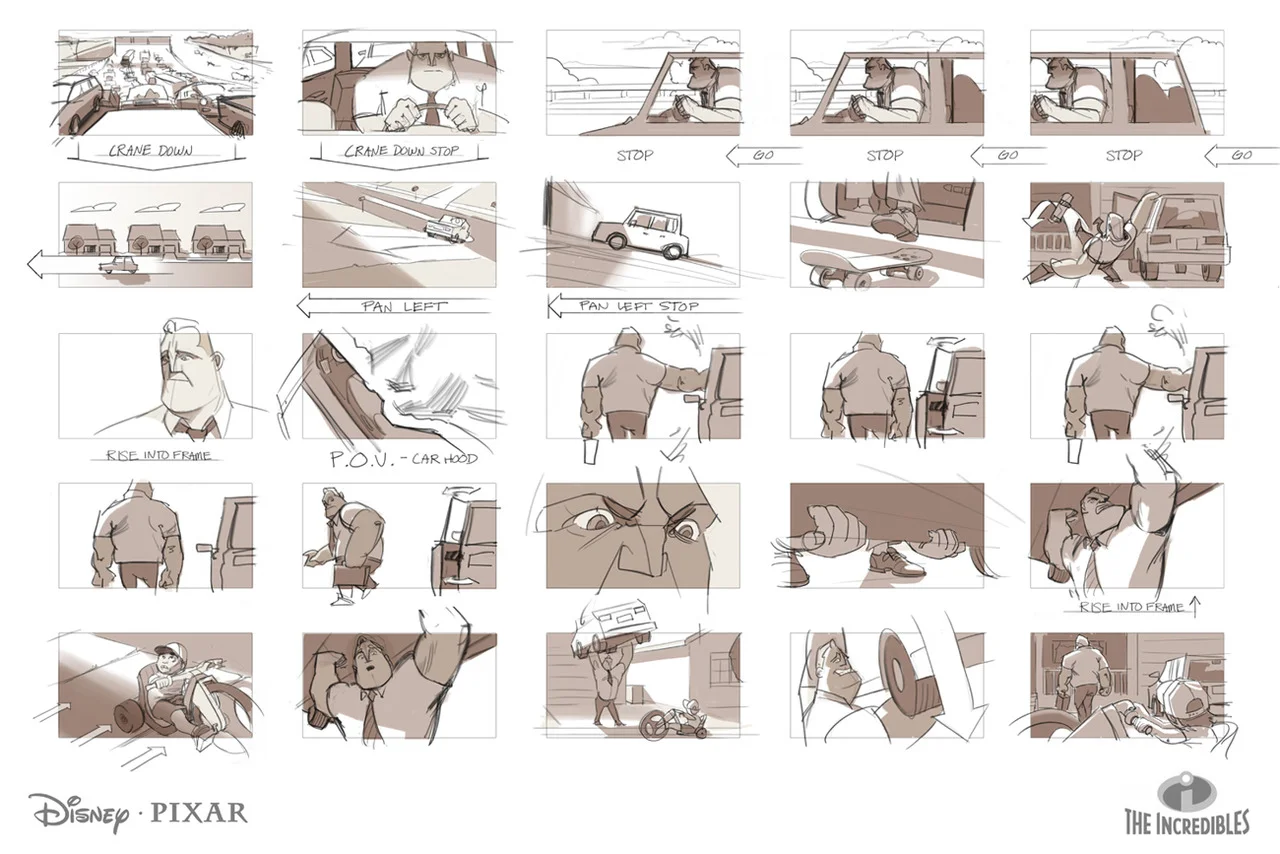
Shooting boards exercise featuring scenes from Disney/Pixar’s The Incredibles. Art by Paul Temple.

Shooting boards exercise featuring scenes from Disney/Pixar’s The Incredibles. Art by Paul Temple.

What Filmmakers Want from Shooting Boards: Save Time, Money and Communicate Clearly

Paul Temple September 2, 2025

In filmmaking, the words “time is money” are not just a cliché. They are the foundation of how projects are planned, budgeted, and executed. Shooting boards and storyboards have become one of the most trusted tools for filmmakers because they offer something rare in the creative process: clarity. But when a director or producer hires a storyboard artist, what are they really asking for? It is not just drawings. It is confidence. It is alignment. It is the ability to see the film before the cameras ever roll. In this post, I want to walk through what filmmakers actually want from shooting boards, why they matter in every stage of production, and how a professional storyboard artist brings value beyond sketches.

The Real Need Behind Shooting Boards

Every filmmaker, no matter their style, has one thing in common: they want their vision executed on screen as closely as possible to what they imagine. Shooting boards are a way of translating those ideas into a language that the entire crew can understand. They strip away confusion and provide a visual blueprint. When a filmmaker sits down with a storyboard artist, what they want most is not art for art’s sake, but a tool that communicates ideas so clearly that misinterpretation is almost impossible.

In essence, shooting boards are pre-visualizations. They are the bridge between the creative chaos of brainstorming and the logistical reality of production. They help directors ask the right questions early. Do we really need a crane shot? Can this dialogue scene be covered in three setups instead of five? Should the camera move or should the actors move? By committing these questions to paper, filmmakers reduce uncertainty and avoid costly mistakes.

Clarity in Communication

One of the biggest challenges on any set is communication. Directors know what they want in their heads, but explaining that vision to a director of photography, production designer, stunt coordinator, or VFX supervisor can feel like a game of telephone. Shooting boards cut through that problem by showing rather than telling.

Imagine trying to describe a complicated tracking shot verbally. You can talk about camera movement, subject framing, and timing, but without visuals there is room for misunderstanding. A shooting board can present that same idea in a single frame or sequence of frames. Every department can look at it and instantly understand how their work supports the shot.

This clarity saves time during production, when every minute matters. Crews no longer have to guess. They do not have to stop and ask for clarification. They already know what is expected because the visual plan has been laid out ahead of time.

Efficiency That Saves Money and Headaches

Filmmaking is expensive. Sets are built, gear is rented, and crews are paid by the day. Every unnecessary delay or mistake has a price tag attached. Shooting boards are a form of insurance against waste.

By planning shots in advance, filmmakers can identify unnecessary setups or overly complex sequences that will eat up valuable time on set. A single drawing might reveal that a complicated crane move could be replaced with a simpler handheld shot without losing impact. That realization saves hours of setup and thousands of dollars in equipment and labor.

Shooting boards also streamline the workflow for the entire crew. The assistant director can build a schedule around them. The cinematographer can plan lenses and lighting. The art department knows exactly what needs to be built or dressed in the background. When everyone works from the same visual guide, production runs smoother, faster, and with fewer surprises.

Creative Confidence

Filmmakers are often working under pressure, balancing creative ambition with practical limitations. Shooting boards provide a form of rehearsal on paper. They allow directors and cinematographers to test ideas visually before committing time and money to them.

This rehearsal creates creative confidence. A director might be unsure if a scene plays better with static shots or moving cameras. By sketching both options, the filmmaker can compare pacing and emotional tone before stepping on set. The board becomes a safe space to experiment without risk.

That confidence matters not only to the director but also to the team. When a crew sees detailed shooting boards, they gain trust in the project. They know the director has a plan. They know what they are working toward. That shared confidence raises morale and helps everyone perform at their best.

Preventing Production Risks

Miscommunication on set can derail even the most carefully planned shoot. Missing shots, continuity errors, or unclear blocking can force costly reshoots or leave a story broken in the editing room. Shooting boards reduce these risks by making potential problems visible before cameras roll.

For example, a board might reveal that two planned shots will not cut together smoothly, or that an actor’s eyeline does not match. Spotting those issues early allows the team to adjust before wasting time and money on set. Shooting boards are not just about inspiration. They are about risk management.

The Storyboard Artist as a Creative Partner

This is where the role of a professional storyboard artist becomes crucial. A filmmaker can sketch rough ideas themselves, but an experienced artist does more than draw. They act as a story consultant. They know how to translate abstract concepts into cinematic language. They understand pacing, framing, camera movement, and how images flow together.

When I work with filmmakers, my role is to listen carefully to their ideas and then transform them into visuals that serve both the creative vision and the practical needs of production. I think about how the boards will be used on set. I design them to be clear, direct, and readable in the fast-paced environment of filmmaking. My job is to bring clarity, not confusion.

In this sense, the storyboard artist is a collaborator. We help directors and producers sharpen their ideas, avoid pitfalls, and communicate more effectively with their teams. The value is not only in the drawings but in the problem solving that comes with them.

Real-World Reflections

Spend a few minutes on any filmmaker discussion forum and you will see the same theme repeated: storyboards and shooting boards are not outdated. They remain vital tools because they make collaboration possible. Directors on Reddit often emphasize that boards keep the crew aligned and eliminate misunderstandings. Others point out how they save time during both shooting and editing by clarifying the intended rhythm of a scene.

This sentiment comes up again and again. In a world where filmmaking technology evolves constantly, from digital cameras to virtual production, the need for clear visual planning has not gone away. If anything, it has grown stronger. The more complex productions become, the more valuable shooting boards are in keeping everyone aligned.

The Takeaway for Filmmakers

At the end of the day, what filmmakers want from shooting boards is not simply a set of pictures. They want peace of mind. They want to know that their vision is clear, their team is aligned, and their production is protected from unnecessary risks.

Hiring a storyboard artist is one of the smartest investments a filmmaker can make. The boards will save time, reduce costs, and boost creative confidence. They will help turn imagination into reality with fewer headaches along the way.

Filmmaking is always a balance of art and logistics. Shooting boards sit at the intersection of both. They allow directors to dream boldly while still giving producers the reassurance that the dream can be executed. That is why they remain one of the most important tools in the filmmaker’s toolkit, and why working with an experienced storyboard artist can make the difference between a production that struggles and one that succeeds.

📩 Reach out: paul@paultemplestudios.com
🎨 Explore more: www.paultemplestudios.com

Want more blog posts on this topic?
1. How Shooting Boards Help Indie Filmmakers Compete with Studio Productions
2.
Common Mistakes Directors Avoid with Shooting Boards
3.
Shooting Boards for Action Scenes: Why Every Great Action Scene Starts on Paper

In Shooting Boards, Film Tags shooting boards, Preproduction, film, directors
Comment
Storyboard for Pepsi Zero’s “Great Acting, or Great Taste?” Superbowl LVII commercial featuring Ben Stiller. Art by Paul Temple.

Storyboard for Pepsi Zero’s “Great Acting, or Great Taste?” Superbowl LVII commercial featuring Ben Stiller. Art by Paul Temple.

Why Directors Depend on Storyboards to Save Time, Cut Costs, and Keep Production on Track

Paul Temple August 18, 2025

Filmmaking is complicated. There are countless moving parts, dozens of departments, and every minute on set costs money. For directors, the pressure is constant. Every shot, every angle, every camera move needs to be thought through well before the crew hits record. That is where storyboards come in. A storyboard is not just a collection of pretty pictures. It is a map, a schedule, and a shared language that keeps the production running smoothly, efficiently, and within budget.

When a director hires a storyboard artist, they are getting more than an illustrator. They are getting someone who translates the vision into clear, actionable visuals. These visuals communicate ideas to every department, from cinematography to art, from set design to stunts. A well-drawn storyboard allows the director to show the team exactly what he wants before the cameras roll. The storyboard is the plan that keeps the train on its tracks.

Communication: A Universal Language for the Crew

One of the biggest challenges on any set is communication. Directors often work with large, diverse teams, and even simple instructions can get lost in translation. Storyboards solve that problem. They give everyone the same visual reference.

Consider a scene with multiple actors, practical effects, and a complicated camera movement. Without a storyboard, the director might spend hours explaining what he wants to the cinematographer, the art department, the gaffer, and the talent. Misinterpretations can happen, leading to mistakes and wasted time. With a storyboard, every department sees the same visual language. The cinematographer understands framing, the art department knows set requirements, and the stunt coordinator sees exactly when and where action happens. The storyboard turns abstract ideas into concrete instructions.

A storyboard also helps when pitching to producers or clients. Seeing the sequence visually builds confidence that the story will play out as intended. It prevents ambiguity and reduces the number of questions the director has to answer on the fly. Clear communication saves time and helps the whole team focus on their work.

Efficiency: Keeping the Production Train on Schedule

Let’s return to the train metaphor. Imagine the director as the conductor of a train, with a team of crew members working as the operators, engineers, and attendants. The storyboard is the train schedule. Each frame represents a stop along the journey. The director sees where the train needs to stop, how long to linger at each station, and when it is time to move on.

When every stop is planned visually, the crew knows exactly what to prepare for. The camera operator knows which lenses to have ready. The set designer knows which props to stage. The lighting team knows how to shape the mood. Everyone is working in sync, moving efficiently from one stop to the next.

Without storyboards, production runs risk of delays. Crew members may guess what the director wants, which often leads to confusion, reshoots, or wasted time resetting equipment. A storyboard gives the conductor confidence that the train will move smoothly from station to station, maintaining momentum without surprises.

Budget: Avoiding Expensive Surprises

Every minute on set costs money. Storyboards are a tool to prevent costly mistakes before the cameras roll. They highlight potential problems and allow the team to plan solutions ahead of time.

For example, a storyboard might reveal that a crane shot or a complex action sequence is logistically impossible with the current setup. Adjustments can be made in pre-production rather than wasting an entire day on set. Similarly, storyboards help identify which shots are necessary and which are extraneous, reducing the number of takes and minimizing overtime.

By planning each moment visually, directors can allocate resources efficiently, avoid unnecessary expenditures, and keep the production on budget. Storyboards provide the foresight that protects both time and money, turning potential chaos into a predictable, manageable process.

Headache Prevention: The Hidden Value of Planning

Production days are stressful. Directors, producers, and crew members are constantly juggling multiple priorities. Storyboards act as a buffer against chaos. They give the team confidence that there is a plan and that every department knows what to do.

When a scene is visualized in advance, last-minute surprises are minimized. The director can focus on performance, pacing, and storytelling instead of constantly problem-solving technical issues. Everyone knows the plan, and everyone trusts that the director has a clear vision. The storyboard becomes a source of reassurance, reducing tension and making the production run more smoothly.

Collaboration: Aligning the Creative Vision

Storyboards are more than logistical tools. They are also collaborative instruments that bring creative partners onto the same page. Directors, cinematographers, production designers, and even clients can all see exactly what the scene will look like. This alignment is critical when working on complex productions.

A storyboard allows everyone to discuss the story using a shared visual language. Feedback can be implemented before production, not after hours of shooting. This fosters collaboration and ensures that the final product reflects the director’s vision without costly corrections or miscommunication.

Subtle Pacing and Emotional Flow

A storyboard also helps directors manage emotional pacing. Each frame is like a signpost showing how the audience will experience a scene. Storyboards let directors control how long to linger on a character’s expression, how to transition between moments, and how to maintain rhythm across the story.

This careful planning guides the audience’s emotional experience. Just as the train lingers at certain stations, giving passengers time to take in the surroundings, storyboards let the director control when to hold a moment of tension, when to release it, and when to move on. This control over emotional tempo is subtle but crucial for effective storytelling.

Conclusion

Directors rely on storyboards for more than pictures on paper. They are essential tools for communication, efficiency, budgeting, collaboration, and emotional pacing. Each frame shows the crew what to do, how to prepare, and how long to spend on each moment. Like a train schedule, the storyboard keeps the production moving smoothly, avoiding confusion, preventing costly mistakes, and allowing the director to focus on storytelling.

Hiring a skilled storyboard artist is an investment in the success of a production. The storyboard becomes the director’s map, manual, and schedule all in one, guiding the team through every stop along the journey. Whether for a commercial, short film, or feature, storyboards are the foundation for a production that is clear, efficient, and creatively satisfying.

📩 Reach out: paul@paultemplestudios.com
🎨 Explore more: www.paultemplestudios.com

Want more blog posts on this topic?
1. How Shooting Boards Help Indie Filmmakers Compete with Studio Productions
2.
Commercials Are Short Films: Why Storyboards Matter Even More in 30 Seconds
3.
What Filmmakers Want from Shooting Boards: Save Time, Money and Communicate Clearly

In Film, AI, Shooting Boards, Storyboards Tags storyboard artist, shooting boards, preproduction
Comment

Black and white shooting boards from a Dell Technologies film project directed by Paul Minor. Art by Paul Temple.

See It Before You Shoot It: The Power of Shooting Boards

Paul Temple July 28, 2025

You’ve got the script. You’ve got the vision. But can your crew see it?

Whether you're shooting a short film, a feature, or a music video, clarity in pre-production can make or break your project. One of the most powerful tools in a director's toolkit is also one of the most overlooked: shooting boards.

Unlike generic storyboards, shooting boards are tailored specifically for production, focusing on camera angles, transitions, timing, and shot composition. When used correctly, they streamline communication, save time on set, and keep your entire crew aligned with the cinematic vision.

If you’ve ever asked:

  • “How do I plan my shots efficiently before filming?”

  • “What’s the difference between storyboards and shooting boards?”

  • “How can I communicate my vision to my Director of Photography and production designer?”

    This post is for you.

1. What Are Shooting Boards?

Shooting boards are sequential illustrations that break down each shot of a scene. They go beyond narrative ideas and focus on technical execution. They include:

  • Camera angles and movement

  • Shot type (wide, medium, close-up, over the shoulder, etc.)

  • Blocking and staging

  • Lighting suggestions

  • Frame transitions and timing cues

While traditional storyboards often focus on conveying general visual ideas, shooting boards dig deeper. They’re designed for logistics, planning, and shot execution. They're used heavily in feature films, TV, music videos, and even high-end branded content.

Think of them as the visual blueprint of your shoot.

2. Why Shooting Boards Matter in Film Production

Film is a collaborative medium. Even if the vision starts with the director, it has to be communicated clearly to:

  • The director of photography

  • Production designers

  • Editors

  • Visual effects teams

  • Line producers and ADs

A well-drawn shooting board aligns all departments before anyone hits record. Here’s why that matters:

a. Better Shot Planning

Directors and DPs use shooting boards to walk through the visual rhythm of a scene. You can pre-visualize how shots will cut together, which helps with:

  • Deciding when to move the camera

  • Planning transitions (match cuts, wipes, etc.)

  • Figuring out shot durations

  • Testing visual pacing in action or dialogue-heavy scenes

b. Improved Communication with Crew

Shooting boards help prevent miscommunication on set. Everyone, from the grip to the production designer, sees the same visual target. That means fewer surprises and faster setups.

c. Efficiency on Set

Time is money, especially with tight schedules. When the shot list is visually prepped, the 1st AD can build a shooting schedule that matches your priorities. And when the crew sees the plan ahead of time, things move faster and smoother.

d. Solving Problems Before They Happen

Logistical problems are easier to catch in the pre-production phase. Does a planned camera move require a dolly track or Steadicam? Will you need additional coverage for a dialogue exchange? Shooting boards let you catch that early before you're burning through hours on set.

3. Case Study: Turning a Complex Sequence Into a Shootable Plan

Let’s say you're directing a fight scene in a warehouse. The script reads fast and punchy, but without visual planning, the stunt coordinator, DP, and editor might each imagine the rhythm differently.

By breaking down the sequence into frame-by-frame shooting boards, you can:

  • Define the beginning, middle, and end of the action

  • Plan dynamic camera movements (for example, a whip pan from a punch to a fall)

  • Pre-vis VFX beats like broken glass or sparks

  • Ensure continuity of direction and eye-lines

This helps the entire team lock in the flow before rehearsal and saves you from reshooting pickups later.

4. How Directors Use Shooting Boards on Set

Shooting boards aren’t just for prep. They become the creative compass on set.

You can use them:

  • During camera setup to confirm framing

  • To communicate shot goals to operators or Steadicam

  • As a checklist during coverage

  • To troubleshoot when time runs short (What shots can we drop and still tell the story?)

Many directors keep them close, sometimes even on their phone or tablet, to reference during fast-moving setups. DPs and script supervisors also rely on them to stay synced.

5. The Human Touch Still Matters

While some filmmakers use AI or 3D previs tools, hand-drawn boards still hold value, especially when created by someone with experience in cinematography and storytelling.

An experienced shooting board artist:

  • Understands lens language and camera blocking

  • Draws with the director’s intent in mind (not just cool images)

  • Adds mood, lighting cues, and emotional beats

  • Collaborates to adjust as ideas evolve

That’s the difference between filler frames and a working document that supports the entire production.

6. What to Look for in a Shooting Board Artist

If you're a director, producer, or 1st AD looking for a board artist, consider:

  • Do they have experience with camera planning and production?

  • Can they match the tone of your project (comedy, horror, drama, etc.)?

  • Are they flexible with changes as the vision develops?

  • Can they deliver under tight deadlines?

The best artists bring cinematic thinking into the frame, not just illustration skill.

7. Final Thoughts: Shooting Boards Are an Investment in the Film

Some filmmakers skip shooting boards to save time or budget. But the cost of miscommunication, slow setups, or extra takes often outweighs the small investment upfront.

Shooting boards aren't just drawings. They’re a creative strategy tool. They align the vision, speed up production, and elevate the final cut.

Need Shooting Boards for Your Next Film?

If you're prepping a narrative film, short, or music video and need professional shooting boards, consider working with a storyboard artist who understands the entire production pipeline.

Look for someone who’s fluent in visual storytelling and camera language. Someone who can take your vision and make it frame-ready.

📩 Reach out: paul@paultemplestudios.com
🎨 Explore more: www.paultemplestudios.com

Want more blog posts on this topic?
1. How Shooting Boards Help Indie Filmmakers Compete with Studio Productions
2.
Common Mistakes Directors Avoid with Shooting Boards
3.
What Filmmakers Want from Shooting Boards: Save Time, Money and Communicate Clearly

In Film, Shooting Boards, Advertising
Comment
← Newer

Search Posts

No results found
 

Featured Blog Posts

Featured
Breaking Creative Ruts: Metaphor and Non-Linear Thinking in Visual Development
March 9, 2026
Breaking Creative Ruts: Metaphor and Non-Linear Thinking in Visual Development
March 9, 2026
March 9, 2026
Hiring a Storyboard and VisDev Artist:  A Step by Step Guide for Filmmakers and Directors
January 7, 2026
Hiring a Storyboard and VisDev Artist: A Step by Step Guide for Filmmakers and Directors
January 7, 2026
January 7, 2026
Composition and Control: The Cinematic Science Behind a Great Frame
November 3, 2025
Composition and Control: The Cinematic Science Behind a Great Frame
November 3, 2025
November 3, 2025
Concept Art and Storyboards for Indie Film Crowdfunding
September 18, 2025
Concept Art and Storyboards for Indie Film Crowdfunding
September 18, 2025
September 18, 2025
 

Latest Blog Posts

Featured
Using Screenwriting Structure in Storyboards for Better Films
June 8, 2026
Using Screenwriting Structure in Storyboards for Better Films
June 8, 2026
June 8, 2026
Learning to Pivot in Pre-Production: Lessons for Directors
May 18, 2026
Learning to Pivot in Pre-Production: Lessons for Directors
May 18, 2026
May 18, 2026
Diving Into the Color Charts of Richard Schmid
May 12, 2026
Diving Into the Color Charts of Richard Schmid
May 12, 2026
May 12, 2026
Negative Space: The Power of What You Leave Out
April 14, 2026
Negative Space: The Power of What You Leave Out
April 14, 2026
April 14, 2026
Color Temperature in Film & Advertising
April 6, 2026
Color Temperature in Film & Advertising
April 6, 2026
April 6, 2026
Imitation and Originality: Why Your Personal Twist Matters
March 30, 2026
Imitation and Originality: Why Your Personal Twist Matters
March 30, 2026
March 30, 2026
Avoiding Flat Diagrammatic Staging in Film & Advertising
March 23, 2026
Avoiding Flat Diagrammatic Staging in Film & Advertising
March 23, 2026
March 23, 2026
Patterns in Nature: Lessons for Cinematic Composition
March 16, 2026
Patterns in Nature: Lessons for Cinematic Composition
March 16, 2026
March 16, 2026
Breaking Creative Ruts: Metaphor and Non-Linear Thinking in Visual Development
March 9, 2026
Breaking Creative Ruts: Metaphor and Non-Linear Thinking in Visual Development
March 9, 2026
March 9, 2026
Camera Movement in Static Boards: Conveying Motion and Energy Without Animation
March 2, 2026
Camera Movement in Static Boards: Conveying Motion and Energy Without Animation
March 2, 2026
March 2, 2026
Behind the Boards: A Blog by Paul Temple

© Paul Temple Studios 2012-2026 All Rights Reserved. Unauthorized use of content from this website is prohibited.