
Directors and producers sometimes worry that their visual development will look too much like everything else. They want something fresh that feels specific to their story, but they also want it grounded in what works on screen. The truth is, every strong artistic voice starts with imitation. You study the masters, copy their techniques, and try to match what you see. But perfect imitation never happens, and that is exactly where the value comes from. If every student could copy a master perfectly, art would stay the same for all human history. What you cannot help but change about your work ends up being the most valuable part of it.
I learned this lesson early in my own career as a storyboard artist, and it shows up every time I sit down to develop visuals for a film or commercial. The example I come back to most often is Franklin Booth, an illustrator from Iowa who became one of the great American pen-and-ink artists in the early twentieth century. Booth taught himself to draw by copying illustrations he found in magazines. He thought those images were straightforward pen-and-ink drawings, so he tried to replicate every line exactly. What he did not realize was that he was actually copying wood engravings. Those prints had been carved into wood blocks, inked, and pressed, creating subtle variations in tone through tiny carved lines. Booth reproduced what he saw with thousands of careful pen strokes, building density and shade by placing lines next to one another. The result was a style that looked like fine etching, full of intricate cross-hatching and dramatic scale contrasts. Large buildings or forests loomed over tiny figures, and classic hand lettering framed the scenes. His work appeared in major magazines like Cosmopolitan, Harper's, and Good Housekeeping from around 1905 to 1935. Contemporaries envied it. No one could match it exactly because it was not a pure copy. It was Booth's misunderstanding turned into something original and beautiful.
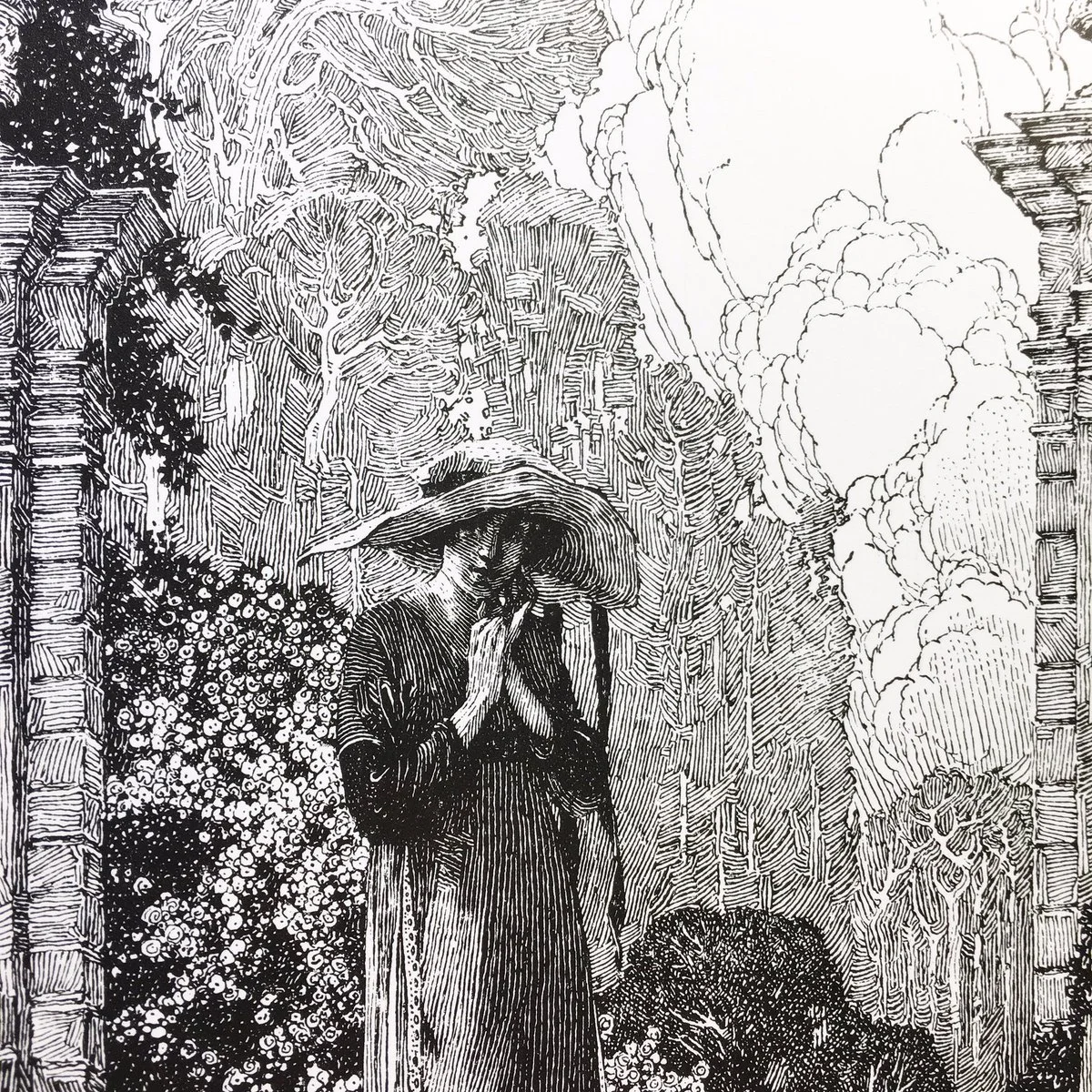
Ink drawing by Franklin Booth.
That story stays with me because it shows how imitation becomes creativity when you add your own hand. Booth did not set out to invent a new technique. He was just trying to get it right. His Iowa background, his limited access to original drawings, and his own way of holding the pen changed the result. Those small, unavoidable differences created beauty that no one else could replicate. The same principle applies directly to visual development and storyboarding for film and TV. When directors hire me, they are not paying for someone who can copy a shot list perfectly. They are paying for the personal twist that makes the boards feel alive and specific to their project.
Why Perfect Imitation Would Kill Creativity
If imitation were flawless, every artist who studied the same master would produce identical work. History would repeat itself in every generation. A student copying Caravaggio would end up with the exact same chiaroscuro lighting. Someone studying Spielberg's storyboards would deliver frames that looked exactly like his. There would be no evolution, no surprises, and no reason for audiences to feel anything new. But that never happens. The human hand, the personal eye, and individual life experience always sneak in. You try to copy the master's line weight or camera angle, but your own sense of rhythm or emotional response shifts it slightly. Those shifts are where originality lives.
Learning from the Masters Without Becoming Them
Every serious artist begins by copying. Copying teaches you to see. You slow down and study how a master handles form, light, or rhythm. But perfect copying is impossible and should not be the goal. The gap between the original and your version is where your own voice emerges.
Franklin Booth's story proves this clearly. Self-taught in rural Iowa with no formal training, he had access only to printed magazines. He copied what he saw, line for line, believing he was learning standard drawing technique. Because he was actually copying wood engravings, his pen could not duplicate the mechanical precision exactly. His thousands of fine lines created tonal variations that felt almost three-dimensional, like etching on metal. His dramatic scale extremes and decorative borders reflected his own sense of wonder at nature and space. The result was a distinctive style that illustrators still study today.
In my own process, I do the same with cinematic references. I might study a sequence from Hitchcock or Fincher, copying the blocking or lighting at first. But when I translate it into storyboards for a new project, my understanding of the script takes over. A low angle that worked for suspense in one film might feel wrong here, so I adjust the height slightly. That adjustment is my input. It turns a generic reference into something that serves this particular story.
Applying Imperfect Imitation to Pre-Production
For directors and cinematographers, this idea has practical value in pre-production. When you hire a storyboard artist, share your references as starting points, then trust the artist to interpret. I start by imitating the composition or lighting the director shows me. But as I draw, the specifics of the script and characters force changes. The frame that looked perfect in the reference now needs a different weight shift or light source to match the emotional beat. Those unavoidable changes are what give the boards their real value.
This matters especially for indie filmmakers working with tight budgets. You cannot afford to shoot endless coverage and fix problems in post. Strong pre-production boards that carry a unique voice help everyone see the film clearly from the start. The director gets visuals that feel specific instead of generic. The cinematographer sees lighting and movement ideas that fit the actual locations. The producer knows the plan is efficient because the artist has already solved problems through personal interpretation rather than blind copying.
AI tools try to shortcut this process by blending millions of existing images. But perfect imitation from AI produces work that has no personal twist. It looks like everything else because it copies without the human element that changes things. A storyboard artist brings lived experience and instinct. Those things guarantee the work will differ from the references in valuable ways.
The Value for Filmmakers
Directors who understand this principle get better results. They do not demand exact copies. They share references and trust the artist to bring their own perspective. The boards that come back carry the DNA of great cinema but feel tailored to this project. That is what makes pre-production efficient and helps the final film stand out.
Wrapping It Up
Imitation is the foundation of every artist's training. It teaches you to see and understand light, form, and rhythm. But perfect imitation would mean the end of creativity. What you cannot help but change… the small shifts that come from your own hand and your own life … those are the parts that matter most. Franklin Booth's story proves it. His mistaken copying of wood engravings gave the world a pen-and-ink style that no one else could match. The same truth holds for visual development and storyboards. The most valuable work comes when an artist imitates the masters but cannot help adding their own perspective.
If you are directing or producing a project and want storyboards or visual development that start with proven techniques but end with something original and specific to your story, reach out. We can explore the references together and let the personal interpretation bring the film to life.
📩 Reach out: paul@paultemplestudios.com
🎨 Explore more: www.paultemplestudios.com
Want more blog posts on this topic?
1. The Fake Perfect Trap and Why Lived In Art Wins Every Time
2. Color Theory, Craft, and the Human Eye
3. Wisdom In The Work: Bezalel And The Tabernacle